
Wondering how to ask for salary hike after a disappointing appraisal? Request a private meeting, present evidence of your contributions and ask for a specific revision. Keep the conversation respectful and agree on a next step.
If the answer is no, ask what would make a future review possible. Meanwhile, you can search for jobs on JobGrin without paying a fee and compare your options before deciding whether to stay.
Quick answer: how do you ask for a salary hike?
The short rule in one line: Make a specific, evidence-based request and agree on what happens next.
- Prepare your case. Connect your achievements and responsibilities to the pay you want.
- Ask for a conversation. Give your manager time to discuss compensation privately.
- Negotiate politely. Ask about the decision, possible alternatives and a review date.
- Keep your options open. Search and apply for jobs on JobGrin without paying a fee.
Use the steps and scripts below to prepare for the conversation.
How to Ask for Salary Hike
Start before the meeting, not with an unexpected question at the end of your appraisal. Your manager needs a clear explanation of what you want and why you believe it is appropriate.
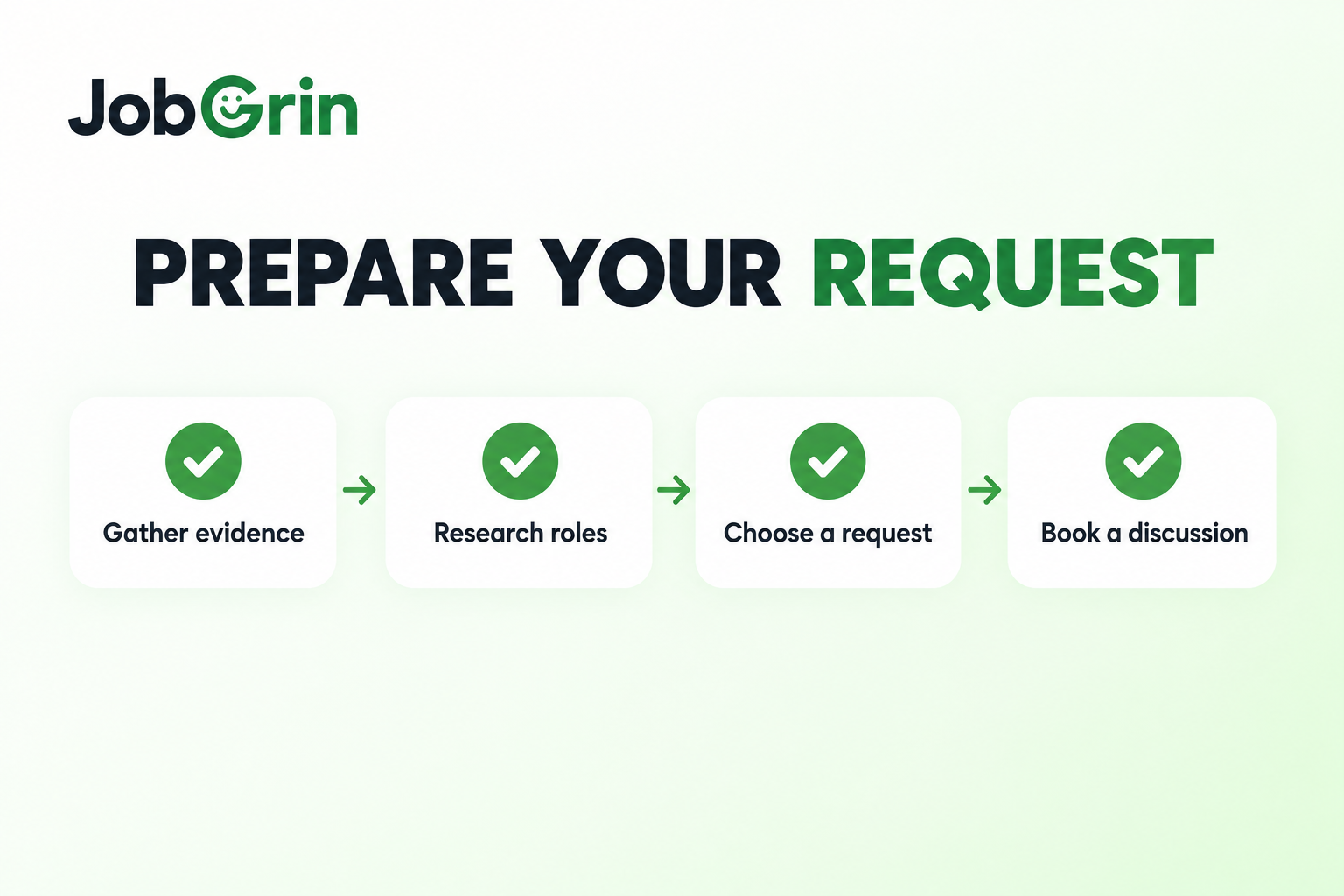
- Gather evidence. Note your strongest contributions, expanded responsibilities and positive feedback. Use results you can explain and support.
- Research comparable roles. Look for roles with similar work, experience requirements and location. Note whether advertised compensation refers to fixed pay or total CTC.
- Choose your request. Decide what revised pay you want and the minimum change you would accept. Keep those figures distinct.
- Book a private discussion. Ask your manager for time to discuss your compensation and progression, rather than raising it in a group meeting.
For example, an operations analyst in Bengaluru could document a process improvement and new reporting responsibilities. The analyst could then compare similar local roles and request a compensation review. This is an example, not a salary benchmark.
Your evidence does not need to be dramatic. A clear record of work delivered, problems resolved and responsibilities added gives your manager material to discuss with decision-makers.
Bring a short summary rather than a long presentation. For each contribution, explain the situation, your action and the result. If a result cannot be measured reliably, describe the change without inventing a figure.
Raise the Topic During an Appraisal
An appraisal is a useful opportunity to connect performance feedback with compensation. If decisions are discussed earlier in your organisation, ask for a meeting before the appraisal conversation.
Start by listening to the feedback. Then connect the discussion to your request:
"Thank you for the feedback. Over this review period, I have [achievement] and taken responsibility for [work]. I would like to discuss revising my compensation to [requested amount or percentage]. How was my current increase decided, and is there room to revisit it?"
Pause after your request. Your manager may need time to explain the decision or speak to someone else. Ask who owns the next decision and when you can expect an update.
If the increase has already been communicated, ask for a review rather than treating the conversation as a demand. A calm request gives you more useful information than an argument about whether the appraisal felt fair.
Ask Your Manager for a Meeting
If your appraisal has passed, you can still request a separate conversation. Make the purpose clear so your manager has time to prepare.
"Hi [manager], could we schedule a meeting to discuss my compensation and progression? I would like to review my contributions, current responsibilities and the scope for a salary adjustment. Please let me know a suitable time. Thank you."
Send the request through your usual work channel. If your organisation has a compensation process, ask your manager how the request fits into it. You do not need to copy colleagues or make the first message confrontational.
If your manager suggests speaking to HR, ask whether your manager will join or support the discussion. Take the same evidence and specific request to that meeting.
Negotiate a Low Hike Politely
Negotiation starts with understanding the decision. Ask what influenced the increase and whether your request can be reconsidered. Avoid assuming that your manager alone controls the outcome.
"I appreciate the increase and the feedback. Given my work on [achievement] and my responsibility for [work], I had expected a revision closer to [request]. Could we discuss whether there is flexibility in the compensation decision?"
If the answer is no, ask what is possible instead. Depending on your priorities, that could mean a later pay review, a different role, a title discussion or support for relevant training. Do not treat a vague promise as an agreed pay rise.
You can also ask how the package is structured. A higher CTC does not necessarily mean the same increase in fixed pay. Ask for the fixed component, variable component and other benefits to be explained separately before comparing options.
Use your own contributions as the centre of the conversation. Personal expenses can explain why pay matters to you, but they do not establish the value of your role. Likewise, avoid presenting a colleague’s pay as a fact unless you have reliable information and a reason to discuss it.
Respond When the Answer Is No
A refusal is useful only if you understand what it means. Ask whether the issue is performance, role scope, timing or a compensation decision. Then request a concrete next step.
"Thank you for explaining. What specific outcomes would support a compensation review, and when could we revisit the discussion? Could we agree on the expectations and review date in writing?"
Listen for details you can act on. A useful response names the work, how it will be assessed and who will revisit compensation. If your manager cannot give a date, ask when you should follow up.
After the meeting, send a short note. Record what was discussed without presenting an undecided request as an approved increase.
"Hi [manager], thank you for discussing my compensation. My understanding is that I will focus on [agreed outcomes], and we will revisit the discussion on [date]. Please let me know if I have missed anything."
Keep a copy of your work summary and update it as your responsibilities change. If the date passes without a conversation, send a polite reminder and refer to the agreed discussion.
Decide Whether to Stay or Explore a Switch
A low hike alone does not tell you whether to leave. Consider the full picture: the work you want to do, your development, your compensation and the clarity of the response you received.
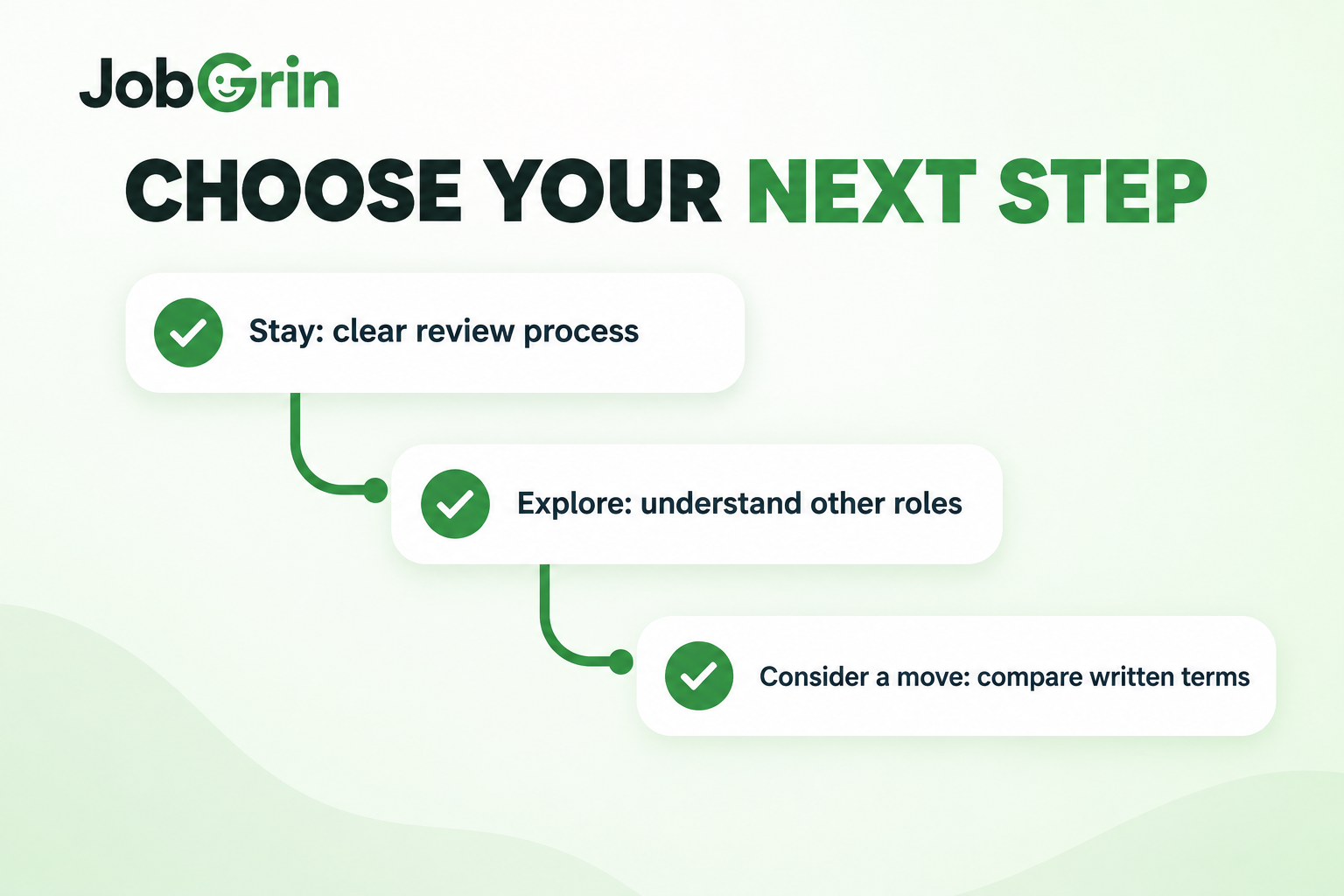
- Consider staying. Your work remains rewarding, the explanation is clear and you have an agreed review process.
- Explore quietly. The response is vague, your responsibilities have grown or you want to understand other roles.
- Consider a move. An opportunity matches your priorities and its written terms are acceptable after a careful comparison.
Exploring does not commit you to resigning. Browse jobs by city, department, role, skill or company to understand the kinds of openings available. Compare responsibilities and requirements, not just job titles.
If another employer makes an offer, compare fixed pay, variable pay, benefits, responsibilities and working arrangements. Read the written terms before making a decision. If your current employer responds with a counter-offer, consider why you began looking as well as the compensation. This guide to accepting a counter-offer covers questions to consider.
Use JobGrin to Prepare Your Options
Whether you stay or move, an updated resume helps you record your recent work. JobGrin’s jobseeker tools give you a way to prepare without paying for a job search or application.
| Tool | What You Can Do | Entry Point |
|---|---|---|
| Job search | Browse and apply for roles | Free for jobseekers |
| Candidate account | Create an account for your job search | Free account |
| Resume Builder | Create or manage a resume with writing suggestions and a live preview | Free tool |
Prices checked on 12 November 2026.
The Resume Builder also includes an ATS score and downloads in PDF, DOCX, TXT and LaTeX formats. Review every suggested phrase and keep only claims you can support.
You can create a candidate account when you are ready to organise your search. Job alerts are also available if you want to follow openings while you continue your current role.
Handle an External Offer Carefully
An outside offer can inform your decision, but use it honestly. Do not invent an offer or imply that you are ready to leave unless you have made that decision. Consider whether you would accept the external role if your current employer says no.
"I have received an offer for [role]. I value my work here, and I would like to discuss whether there is scope to review my compensation. Could we discuss the options and a timeline for a decision?"
Share only what you are comfortable sharing. If your manager asks for documentation, consider the information contained in it before responding. Do not assume a counter-offer will address concerns about your role, workload or progression.
If you decide to interview elsewhere, prepare a constructive explanation for your search. Focus on the work and opportunities you want rather than criticising your current manager. Our guide to answering why you are leaving your current job can help you frame that conversation.
Mistakes That Weaken Your Request
Making the request too vague. Saying you deserve more does not tell your manager what you want. State your proposed adjustment and the reasons for it.
Using unsupported claims. Do not guess at team results or claim credit for someone else’s work. Be clear about your contribution and the evidence behind it.
Comparing unlike packages. A total CTC figure and fixed pay do not answer the same question. Separate the components before deciding whether an offer meets your needs.
Leaving without a next step. If no decision is available, ask who will respond and when. Send a short follow-up that records the discussion accurately.
Issuing an empty ultimatum. A threat can change the conversation. Raise a possible departure only when it is genuine and you are prepared for the answer.
Frequently Asked Questions
How do I ask for a salary hike in an appraisal?
Connect your request to the work and responsibilities discussed in the review. State the adjustment you want, then ask how the decision was made and whether it can be revisited.
What should I say when my hike is lower than expected?
Thank your manager for the feedback, explain the gap between the decision and your request, and ask whether there is room to review it. Keep the discussion focused on evidence.
How do I ask for a salary hike politely by email?
Use email to request a private meeting. Mention compensation and progression, briefly refer to your contributions, and ask for a suitable time. Save the detailed negotiation for the conversation.
Should I ask my manager or HR for a salary hike?
Start with the person who manages your work unless your organisation directs you elsewhere. If HR handles compensation discussions, ask your manager how to involve the right people.
How do I negotiate if the appraisal decision is final?
Ask when the decision can next be reviewed and what evidence would support a change. You can also discuss role progression or other priorities without assuming they replace a pay increase.
What if my manager says there is no budget?
Ask when compensation decisions will next be considered and whether you can agree on a review date. Use the answer to decide whether the timeline fits your priorities.
Can I ask for a hike after accepting an appraisal?
You can request a further conversation. Explain the contributions or responsibilities you want considered and ask whether a review is possible, rather than assuming the earlier decision will change.
Should I mention another job offer?
Mention a genuine offer only if you are comfortable discussing it and have considered your choices. Compare the written terms and be prepared for your employer not to match it.
What should I do after a salary discussion?
Send a brief summary of any agreed actions and review date. If you are exploring roles, update your resume and prepare for interviews. You can also use this guide to prepare for an online job interview.
Final Thoughts
Knowing how to ask for salary hike is about making your case clearly and learning what the response means. A specific request and a written follow-up give you a better basis for your next decision.
Give an agreed review a fair chance if it fits your priorities. If it does not, explore roles carefully and compare the complete opportunity before making a move.
Leave a Reply