To understand how to hire mechanical engineers, start with the work your Gujarat manufacturing unit needs done. Define the role, test relevant skills and compare candidates against the same criteria. On JobGrin, posting a job starts with Free Starter at ₹0 per post.
A design engineer and a production engineer solve different problems. This guide helps you write each job description, choose practical assessments and find candidates for your plant.
Quick answer: how do you hire mechanical engineers?
The short rule in one line: Match the role, test and sourcing channels to the work at your plant.
- Define the responsibility. Separate design, production, maintenance and quality work before writing the vacancy.
- Use a relevant work sample. Ask design candidates to review a drawing and production candidates to diagnose a process issue.
- Search by location and skills. Include the Gujarat plant location, practical requirements and relocation expectations.
- Choose a posting plan. JobGrin Free Starter begins at ₹0 per post.
Start with the role comparison below, then adapt the templates and assessment to your vacancy.
Choose the Engineering Role Before You Advertise
List the decisions the new hire will own, the equipment or products involved and the people they will work with. A clear scope helps you avoid receiving applications for the wrong kind of mechanical role.
| Role | Main responsibility | Useful evidence |
|---|---|---|
| Mechanical design engineer | Develop drawings and designs that can be manufactured and tested. | CAD work, drawing interpretation, material choices and design reviews. |
| Production engineer | Support manufacturing processes, output, quality and shop-floor coordination. | Process improvement, production planning and problem-solving examples. |
| Maintenance engineer | Maintain equipment and investigate machine failures. | Preventive maintenance, fault diagnosis and repair coordination. |
| Quality engineer | Inspect and investigate product or process quality issues. | Measurement methods, root-cause analysis and corrective actions. |
Choose a design role when drawings, prototypes or product changes are the priority. Choose a production role when the immediate need is a stable and effective manufacturing process.
A smaller unit can combine responsibilities, but make the balance explicit. For example, explain whether production support is the main job and drawing changes are an occasional task. Identify the reporting manager and the decisions the engineer can make independently.
Review mechanical jobs on JobGrin for examples of how employers present role requirements. Use them as a starting point, not as a substitute for your own plant requirements.
Choose a Job Posting Plan
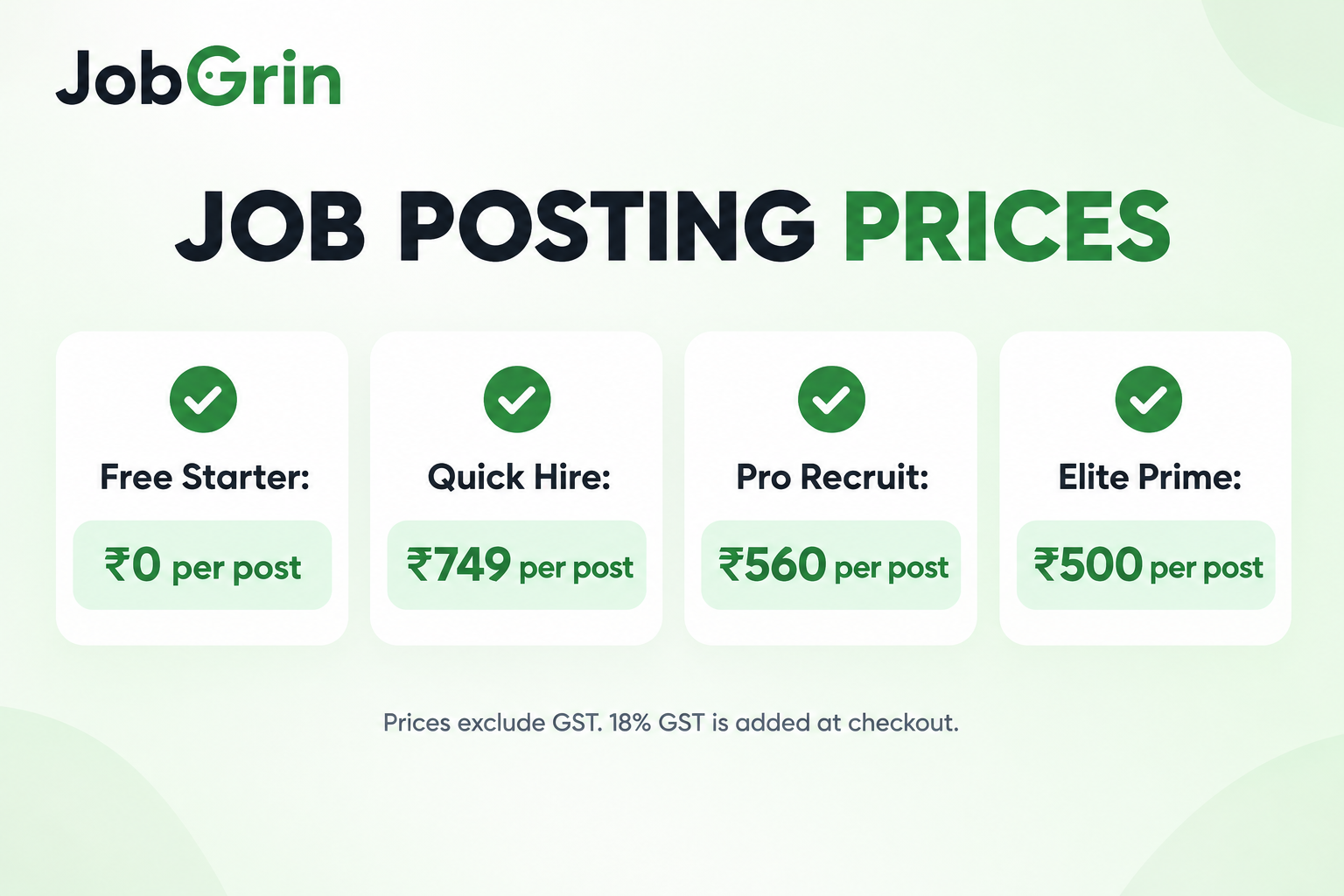
Consider how many vacancies you need to publish and how long you want each post live. JobGrin offers free and paid job posting plans, with free drafts. The employer pricing page sets out the options.
| Plan | Price excluding GST | Posting allowance | Applications and duration | Selected features |
|---|---|---|---|---|
| Free Starter | ₹0 per post | 3 posts per month | Up to 25 applications per post; each job live for 7 days | Email alerts |
| Quick Hire | ₹749 per post | 1 post | Up to 150 applications; live for 15 days | Priority listing, 72-hour search boost and basic AI matching |
| Pro Recruit | ₹560 per post | 5 posts | Unlimited applications; each job live for 30 days | Featured listings, AI candidate suggestions and priority support |
| Elite Prime | ₹500 per post | 10 posts | Unlimited applications; each job live for 45 days | Top search placement, advanced AI matching and premium support |
| Custom plan | Discuss requirements | For hiring across more than 10 roles | Discuss requirements | Custom hiring plan |
Prices checked on 12 November 2026. Prices exclude GST; 18% GST is added at checkout.
For a package calculation, Pro Recruit costs ₹560 per post × 5 posts = ₹2,800 excluding GST. Elite Prime costs ₹500 per post × 10 posts = ₹5,000 excluding GST. Choose a package based on your actual vacancies, not just its per-post price.
Write a Mechanical Design Engineer Job Description
A useful mechanical design engineer job description names the product, design tools and manufacturing constraints. Avoid asking for every skill your organisation uses. Distinguish essential requirements from skills the engineer can learn after joining.
Use this template and replace the brackets with your actual requirements:
“Mechanical Design Engineer, [plant or office location], Gujarat. You will develop and revise mechanical designs for [product or equipment]. Your work includes preparing CAD models and drawings, reviewing tolerances, supporting prototype tests and coordinating design changes with production and suppliers. Essential: [qualification], experience with [CAD tool] and ability to interpret manufacturing drawings. Useful: experience with [process or product]. Reporting to: [manager]. Work arrangement: [on-site or other arrangement]. CTC range: [range]. Apply with a CV and examples of relevant work that you are permitted to share.”
Specify the manufacturing processes that matter, such as machining, fabrication or assembly. Explain whether the engineer will create new designs, maintain existing drawings or support both. If the role includes site visits or supplier discussions, say so.
Ask for a portfolio only when it helps assess the work. Candidates should remove confidential drawings, dimensions and customer details. They can also explain their contribution without sharing proprietary files.
Write a Production Engineer Job Description
A production engineer job description should show the process the hire will support and the problems they will own. Include the shift arrangement, reporting line and whether the work involves supervision.
“Production Engineer, [plant location], Gujarat. You will support production of [product] using [processes or equipment]. Responsibilities include coordinating daily production, reviewing process problems, working with quality and maintenance teams, and documenting improvements. Essential: [qualification], experience with [relevant process] and ability to read production information. Useful: experience with [equipment or improvement method]. Reporting to: [manager]. Shift arrangement: [details]. CTC range: [range]. Apply with a CV and a brief example of a production problem you helped solve.”
Avoid vague requirements such as excellent technical knowledge without context. Instead, name the machines, materials or process records the candidate will encounter. Explain whether the position focuses on line coordination, process engineering or both.
For either role, the JobGrin job description template can help you organise responsibilities and requirements. Keep your criteria consistent with the actual work rather than copying an unrelated vacancy.
Test Design and Shop-Floor Skills
Use a short work sample that resembles the job. Give all candidates for the same role the same instructions, information and time. Tell them how you will assess their response and let them explain their assumptions.
Design Work Sample
Give the candidate a fictional component drawing and a manufacturing process. Ask them to identify unclear dimensions, discuss a tolerance and suggest a practical design change. Listen for how they balance function, manufacturability and inspection.
Do not expect access to a particular CAD licence during an initial discussion. A marked-up drawing and an explanation can reveal the candidate’s reasoning. If CAD operation is essential, arrange a separate exercise using the actual tool and a neutral test file.
Production Work Sample
Present a fictional line problem, such as repeated dimensional variation after a machine adjustment. Ask what the engineer would check first, which records they would review and whom they would involve. A strong response separates immediate containment from investigation and longer-term action.
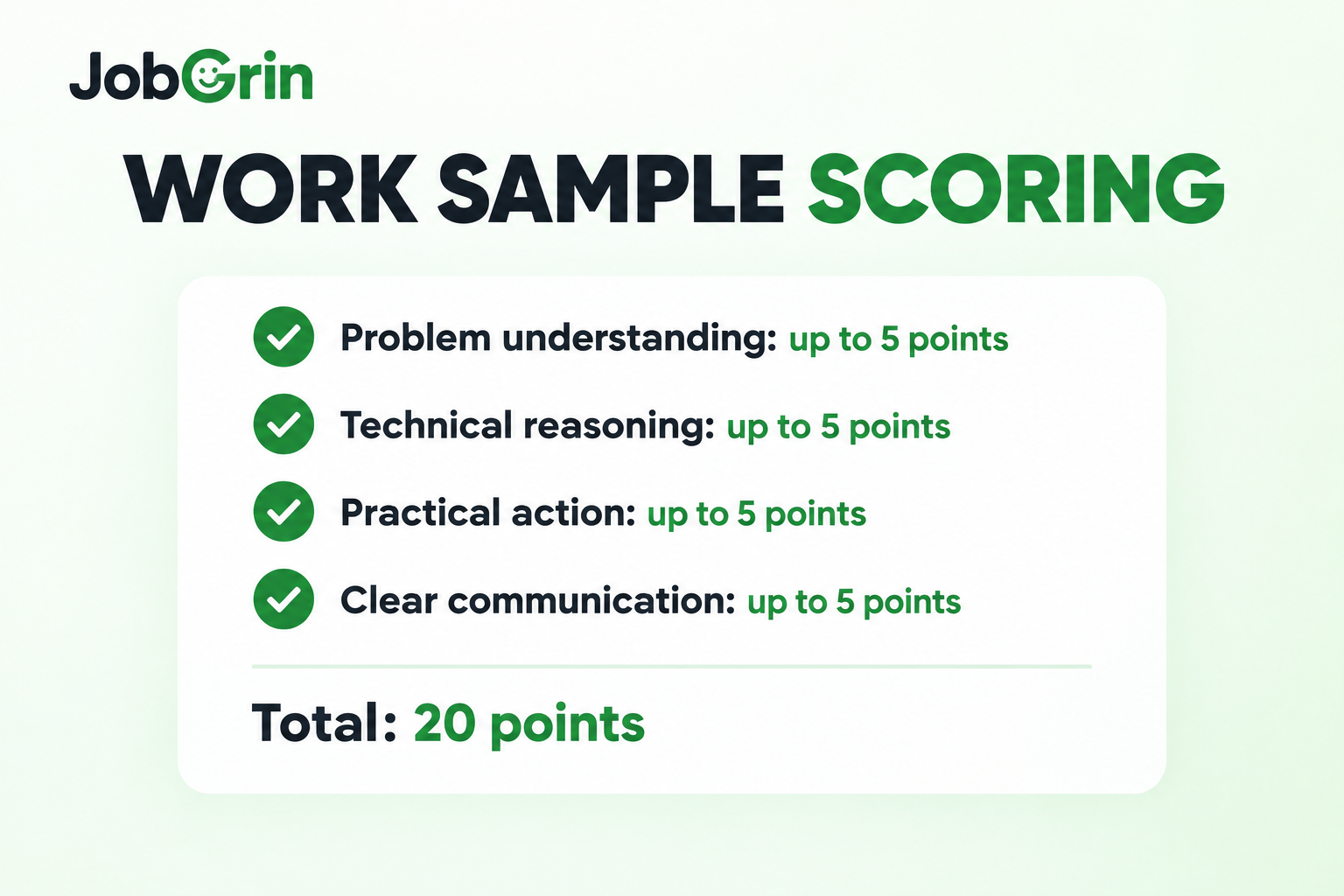
For either exercise, use this suggested scoring guide. Award up to 5 points for each criterion, for a total of 20 points: problem understanding, technical reasoning, practical action and clear communication. Record evidence for every score rather than relying on overall confidence.
Discuss safety as part of the proposed work. Ask candidates what information they need before approaching equipment or changing a process. The aim is to understand their judgement, not to reward a memorised answer.
Find Candidates for a Gujarat Plant
Start with the plant city and surrounding commuting area. If the role requires daily attendance, say so early. If relocation is an option, state what support, if any, your organisation offers without assuming every applicant can move.
Use role-specific search terms alongside the location. For design, combine mechanical design with relevant CAD tools or processes. For production, combine production engineer with the manufacturing process, equipment or product category.
On JobGrin candidate search, filters include keywords, experience, location, relocation, department, role and industry. Try a focused search first, then broaden individual filters if the results are too narrow. Review the work history, not just the job title.
Browse engineering jobs to see how related roles are framed. You can also approach relevant engineering colleges, professional networks and employee referrals. Give every source the same job description and assessment criteria.
For an example, a hiring manager at a manufacturing unit near Vadodara needs an engineer for fixture drawings. A search for mechanical design and fixture-related experience is more useful than a broad search for any engineer. The manager can then ask about the candidate’s own contribution to a drawing or prototype.
Shortlist Fairly Against the Work
Before reviewing applications, agree on the essential skills with the hiring manager. Separate them from preferences such as experience in a particular product category. This prevents an attractive CV from changing the standard halfway through the search.
Look for evidence of relevant work: a design revision, a machine or process supported, an inspection problem investigated, or an improvement the candidate helped implement. Ask what the candidate personally did and what the team did.
Do not reject a candidate solely because their previous title differs. A person working in product development could have strong design experience. A shop-floor engineer could have relevant production experience under another title.
Use a consistent review note for each applicant: relevant experience, evidence against essential skills, questions to clarify and next decision. Where evidence is missing, ask a focused question rather than assuming the candidate lacks the skill.
JobGrin’s employer hiring guide explains how to use the platform during the search. Keep candidate communications clear, including the job location and expected next step.
Interview for Decisions, Not Memorised Answers
Use the work sample as the centre of the technical interview. Ask the candidate to explain a choice, identify an alternative and describe what they would do with missing information. Follow the same core questions for each candidate in the same role.
- For design. How would you change a drawing that assembly teams find difficult to use?
- For production. What would you investigate when output changes after a process adjustment?
- For quality. How would you separate a measurement issue from a manufacturing issue?
- For coordination. How would you handle disagreement between production and design about a change?
Probe the candidate’s actual contribution. Ask what they checked, which colleagues they consulted and what happened after the decision. Avoid treating a polished presentation as proof of technical competence.
Discuss practical conditions before making a decision: plant location, shifts, reporting structure, CTC expectations and joining availability. Give the candidate time to ask about equipment, team support and the role’s priorities.
Make the Decision and Prepare for Joining
Combine the application review, work sample and interview notes. Compare each candidate against the role criteria, not against another candidate’s personality. If the evidence is incomplete, use a targeted follow-up question.
Once you select a candidate, communicate the role, location, work arrangement and agreed compensation clearly in the offer. Explain the next steps and give the candidate a contact for questions. Handle references and documents through your organisation’s established process.
Before the engineer joins, prepare the reporting line, access to relevant drawings or process records and an introduction to the shop-floor team. Agree on initial priorities with the manager. For a design hire, this could be understanding a product and its drawing controls. For a production hire, it could be learning the line and escalation process.
After the search, review which sourcing terms and assessment questions helped you understand candidates. Update the job description when the work changes. That record will make the next vacancy easier to define.
Frequently Asked Questions
What should I look for when hiring a mechanical engineer?
Look for evidence that matches the work: design reasoning, production experience, maintenance knowledge or quality investigation. Check how the candidate applies that knowledge through a relevant work sample and interview.
How do I assess a mechanical design engineer?
Ask the candidate to review a fictional drawing and explain dimensions, tolerances and manufacturing choices. If CAD use is essential, include a separate exercise in the tool used by your team.
What should a production engineer job description include?
Include the plant location, product, process, equipment, responsibilities, reporting line and shift arrangement. Distinguish essential experience from useful additional skills.
Where can I find mechanical engineers in Gujarat?
Post a role on JobGrin and search candidate profiles by location, experience and skills. Engineering colleges, professional networks and employee referrals are other channels to consider.
Should I hire a design or production engineer?
Hire for design when drawings, products and prototypes are the main need. Favour production when the main need is supporting and improving manufacturing processes.
Can I assess a candidate without requesting confidential designs?
Yes. Use a fictional component or ask for an explanation of previous work without proprietary details. A candidate can discuss their contribution without sharing an employer’s drawings.
How should I compare candidates for the same engineering role?
Use the same essential criteria, work sample and core interview questions. Record evidence for your scores and follow up on gaps before making the decision.
How much does it cost to post an engineering job on JobGrin?
Free Starter begins at ₹0 per post. Paid plans start with Quick Hire at ₹749 per post excluding GST; 18% GST is added at checkout.
Final Thoughts
Knowing how to hire mechanical engineers starts with defining the work your plant needs done. A focused description and a realistic assessment make it easier to compare relevant evidence.
Keep the hiring manager involved, communicate the working conditions early and document the reasons for your decision. Then prepare the team and the information the new engineer needs to begin.
Leave a Reply