Is AI Really Taking Jobs in India? What the 2026 Data Actually Shows
Open LinkedIn on any given day and you’ll find someone predicting mass unemployment by next year, right next to someone else hiring for an “AI-augmented” version of the exact job that was supposedly about to disappear. Both posts get traction. Both can’t be fully right.
So here’s the question worth actually answering: if you’re job hunting in India in 2026, should you be worried about AI taking your job, or is this mostly noise?
The honest answer: for two out of three Indian job seekers, the fear of job loss due to AI in India is overblown. For the other one in three, it’s completely justified. The data tells you which group you’re in, and it’s not about your industry, it’s about your actual task list.
The Headline Fear vs. The Real Data
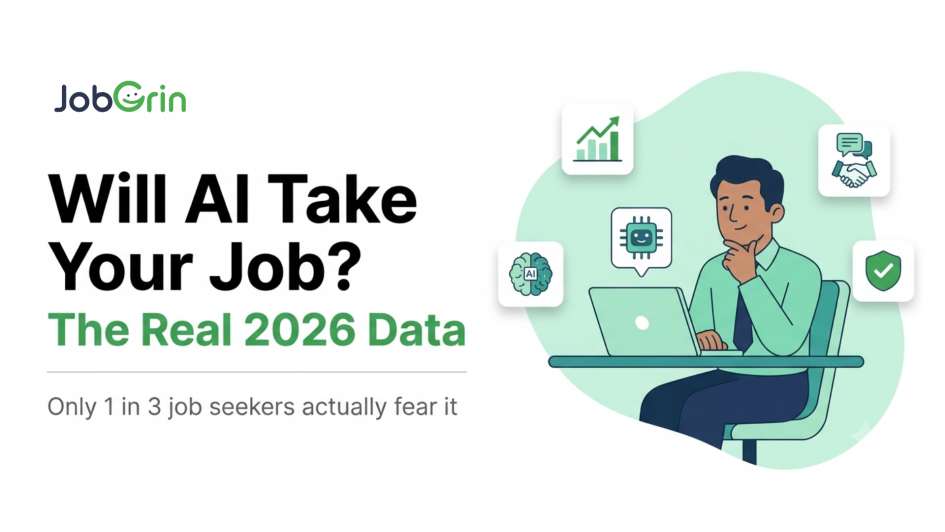
Let’s start with the actual numbers instead of the anxiety. Reports say more than 60,000 Indian job seekers, thousands of job listings, and recruiter surveys found that 86% of respondents see AI as a friend rather than a threat to their career. Only about one in three said they specifically feared losing their job to AI.
That’s a very different picture from what social media would have you believe. It doesn’t mean AI isn’t changing the job market, it clearly is, but it means most working professionals in India aren’t experiencing AI as a layoff machine. They’re experiencing it as a tool that’s reshaping how their job gets done, and in many cases, as a skill that’s actively boosting their pay.
The hiring data backs this up. AI and ML-related hiring in India has been growing consistently faster than the overall job market, repeatedly posting year-on-year growth in about 30-45% range across recent quarters, even while some traditional IT hiring stayed flat. Freshers entering roles with AI exposure have seen salary premiums as high as roughly 56% over peers without those skills. Senior professionals with 13+ years of experience and AI fluency have seen premiums above 30%.
So the question isn’t really “is AI taking jobs.” It’s “which jobs, and what kind of impact.” That’s where most coverage of this topic stops short, and where it actually gets useful.
Which Jobs Are Actually at Risk From AI in India
Not every role faces the same exposure. Painting AI as either a universal threat or a universal non-issue both miss the point. The real picture splits cleanly into two categories.
Roles With Real Exposure
Jobs built around repetitive, rules-based, high-volume tasks are the ones genuinely being reshaped or reduced by AI tools:
- First-level data entry and basic data processing – where pattern-matching software can now do in seconds what used to take a person an afternoon
- Entry-level content drafting and formatting – not creative strategy, but the high-volume, low-judgment writing tasks
- Basic-tier customer support – chatbots and AI agents now handle a meaningful share of tier-1 queries that used to require a human on the phone
- Routine quality-checking tasks in operations – anywhere a checklist can be automated, it increasingly is
If you’re stuck doing this kind of work daily, it might be worth reading about routine MIS and reporting tasks that are already shifting toward AI tools.
If your day-to-day work matches one of the patterns above almost entirely, with very little judgment, negotiation, or relationship-handling layered on top, that’s the segment where AI genuinely changes hiring volume, not because companies hate workers, but because the economics of automating predictable tasks are hard to ignore.
Roles AI Is Creating, Not Destroying
On the other side, AI adoption is actively expanding hiring in some surprising places. Sectors like Banking, BPO, Accounting, and KPO, not traditionally thought of as “AI sectors” have all posted strong year-on-year growth in AI-related roles, in some cases above 40%. This isn’t just AI engineers being hired; it’s existing roles in these sectors being redefined to include AI-tool fluency as a core skill, which raises pay rather than cutting headcount.
The pattern is consistent: wherever a role combines AI-assisted efficiency with human judgment, relationship management, or domain expertise, demand is growing, not shrinking. A finance analyst who can use AI tools to model faster is more valuable, not less. A recruiter who uses AI to shortlist faster gets more done, not replaced.
The Hidden Worry Nobody’s Talking About
Here’s the part most coverage of this topic completely misses, and it matters more than the headline fear of job loss.
The reports found that the bigger anxiety isn’t actually about losing a job, it’s about losing creative relevance. Among high earners, nearly 40% reported being more worried that AI would erode the creative or distinctive value of their work than about being laid off outright. That concern is sharpest in fields like animation and VFX (over half of professionals surveyed), film and music, and advertising, sectors where the entire value proposition is originality.
If you work in a creative or strategic field, this is the more honest conversation to have with yourself: not “will I be replaced,” but “will AI commoditize the part of my work that used to set me apart.” That’s a different problem, and it has a different solution, leaning further into judgment, taste, and original thinking that AI tools genuinely can’t replicate, rather than competing with AI on output speed.
If you work in an operational, process-driven, or routine-task-heavy role, the more relevant question really is the traditional one: is this specific task getting automated, and what’s the next role up the ladder that adds the judgment AI can’t.
How to AI-Proof Your Career in 2026
“Learn AI” is the advice everyone gives and almost nobody makes specific. Here’s what actually moves the needle, broken down by where you sit today.
If you’re in an operational or process-driven role:
Learn to operate the AI tools relevant to your specific function, not AI in general. A logistics coordinator should learn the route-optimization and demand-forecasting tools used in their sector. An accounts executive should get fluent in AI-assisted reconciliation and reporting tools. The goal isn’t to become a data scientist, it’s to become the person who runs the AI tool instead of being replaced by it.
If you’re in a creative or strategic role:
Resist the urge to compete with AI on volume or speed. Double down on the things that require taste, context, and original judgment, the parts of your work a prompt can’t replicate. Use AI for the repetitive 70% of the job (drafts, variations, research) and protect your time for the 30% that actually requires you.
If you’re early career or a fresher:
This is genuinely the best time to build AI fluency into your skillset from day one, rather than retrofitting it later. Fresher hiring in roles with real AI project exposure has consistently commanded a measurable salary premium over generic entry-level hiring. Employers are explicit about this: many want candidates with hands-on project exposure, not just a certificate.
Not sure where to start? Here’s a 6-step roadmap into data science that shows what real AI project exposure actually looks like.
Across every level:
Roughly one in three job seekers say they want hands-on AI exposure beyond theoretical learning, and that instinct is correct. A two-line mention of “AI skills” on a resume convinces nobody. A specific project, even a small one, demonstrating that you’ve actually used an AI tool to solve a real problem in your domain is what gets noticed.
What To Do If You’re Already Worried About Your Job
If you’re reading this because you have a specific, immediate worry about your current role, here’s a practical sequence rather than vague reassurance.
- Get honest about your task mix. List what you actually spend your week doing. If 80% of it is repetitive and rules-based, that’s useful information, not a reason to panic, but a reason to start building the adjacent skills now, while you have time and a job.
- Talk to your manager about AI tools already in use at your company. Being the person who proactively learns the tool, rather than the person who resists it, changes how you’re seen internally, and it’s far easier to do this from inside a company than after a layoff.
- Look at how your specific role is trending in hiring data, not the market overall. A role can be growing nationally while shrinking at your specific company, or vice versa. Search your exact job title plus “hiring trends 2026” before assuming the worst.
- If you do need to move, target sectors actively expanding AI-adjacent hiring, Banking, BPO, Accounting, Insurance, and Hospitality have all shown strong non-IT hiring growth alongside AI adoption, often in non-metro cities where competition for roles is lower.
- Update your resume to show outcomes, not just tasks, especially any outcome where you used a tool (AI or otherwise) to do something faster or better. This is the single most common gap recruiters report seeing.
Frequently Asked Questions
Is AI actually causing mass job losses in India right now?
No, not at the scale headlines suggest. Large-scale survey data shows only about one in three Indian job seekers fear AI-driven job loss, and AI/ML hiring has been growing significantly faster than the overall job market in recent quarters. The bigger real-world trend is role transformation, AI changing what a job involves, rather than wholesale elimination of jobs across the board.
Which jobs are most at risk from AI in India?
Roles built almost entirely around repetitive, rules-based tasks face the most genuine disruption, basic data entry, routine tier-1 customer support, and high-volume low-judgment content formatting are the clearest examples. Roles that combine repetitive tasks with judgment, negotiation, or relationship management are far more resilient, because AI tools tend to support that work rather than replace it.
Do I need to learn AI skills even if I’m not in tech?
Yes, in a practical, role-specific sense. You don’t need to become a data scientist, but learning the AI tools specific to your function, whether that’s finance, logistics, HR, or customer service, is increasingly what separates candidates who get the salary premium from those who don’t. Sectors like Banking, BPO, and Accounting are hiring for exactly this kind of AI-augmented role today.
Should freshers worry about AI taking entry-level jobs?
Freshers should worry less about AI taking jobs and focus more on entering with AI exposure already built in. Data shows freshers with real, hands-on AI project experience are seeing meaningfully higher starting salaries than peers without it. The entry-level jobs most at risk are the most repetitive ones, freshers who can show judgment and tool fluency, even in small project form, are in a strong position.
The Bottom Line
The fear of AI-driven job loss in India is real, but it’s far narrower and more specific than the headlines suggest. Most Indian professionals aren’t watching their jobs disappear, they’re watching their jobs change, and the ones who adapt fastest are seeing real salary upside for it. The genuine risk sits with repetitive, rules-based roles and with high-earning creative professionals worried about originality, not with the workforce broadly.
If you’re navigating a career decision in this environment, whether that’s upskilling in your current role or actively job hunting for something more secure, JobGrin connects you with employers across India’s fastest-growing job markets, including the Tier 2 and Tier 3 cities where non-metro hiring is currently outpacing the big metros. Browse current openings and see exactly which sectors are hiring for the skills you already have.
Leave a Reply