Every interviewer has heard the same answer a thousand times. Name, education, hardworking, team player, thank you for the opportunity. It tells them nothing, and it puts you in the same pile as every other candidate who walked in before you.
“Tell me about yourself” isn’t a warm-up question. It’s the interviewer deciding, in the first ninety seconds, whether the rest of the interview is worth their full attention. Learning how to answer “Tell me about yourself” well means understanding what the question is really checking, then building a response that fits your background.
This guide gives you the exact framework, ready-to-adapt templates for six different career stages, and the specific mistakes that make interviewers tune out.
TL;DR
- Use the Present–Past–Future framework to structure your answer.
- Start with who you are professionally, then highlight relevant experience, skills, or projects.
- Mention one strong achievement you can explain if the interviewer asks for details.
- Finish by connecting your background to the role you’re applying for.
- Keep your answer around 60-90 seconds and avoid repeating your full resume, family details, or generic qualities like “hardworking.”
- Tailor the answer to each job instead of memorizing the same response for every interview.
What This Question Is Actually Checking For
The interviewer already has your resume. They’re not asking you to repeat it. They’re checking three things at once: can you communicate clearly under mild pressure, do you understand what this specific role needs, and can you connect your background to that need without being told to.
Your answer also sets the direction of the interview. Mention a project, and expect a follow-up question about it. Mention a skill, and expect them to test it. Treat your opening answer as the table of contents for everything that follows, not a closing statement.
The Present-Past-Future Framework
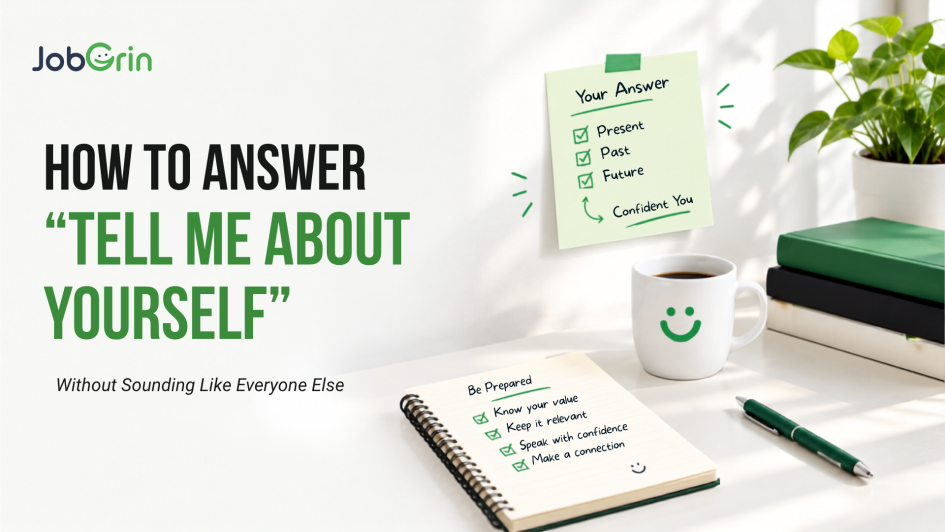
The simplest way to structure your answer is Present, Past, Future.
Present – who you are professionally right now.
Past – the experience, education, or projects that back that up.
Future – why this specific role is the next logical step.
Here’s what that looks like assembled:
“I’m a digital marketing executive with two years of experience in SEO and content strategy. In my current role, I handle keyword research, on-page optimization, and monthly performance reporting, and I recently worked on a campaign that grew organic traffic significantly through technical fixes and content restructuring. I’m now looking for a role where I can take on larger SEO ownership and work with a bigger content team.”
Notice what’s missing: no family background, no hobbies, no “I am hardworking and honest.” Every sentence does a job. Swap in your own numbers and role, and the same three-part shape works whether you’re a fresher or twelve years into your career.
Build Your Answer in Five Steps
- Write one sentence for your current position. If you’re a student or fresher, this is your degree and area of interest instead of a job title.
- Pick two or three relevant experiences. Not everything you’ve ever done. Only what this employer would care about.
- Name your strongest relevant skill. One skill, backed by a real example, beats five skills with no proof behind them.
- Choose one achievement or project. Something you can explain in detail if asked, because you will be asked.
- Connect it to the role you’re interviewing for. Read the job description before the interview and mirror its language here.
Run those five answers together, and you have a complete response. Don’t memorize it word for word. Memorize the five points, and let the delivery sound like you, not a script.
Templates for Every Career Stage
Freshers
Focus on your degree, projects, internships, and certifications instead of work experience you don’t have yet.
“I recently completed my [degree] with a strong interest in [field]. During my studies, I worked on [project/internship], where I built skills in [relevant skills], and I also completed [certification]. I’m now looking for an entry-level role where I can apply what I’ve learned and grow into a larger position.”
Experienced Professionals
Lead with your current responsibilities and one measurable result. Skip the full job history.
“I’m a [job title] with [X] years of experience in [industry]. In my current role, I’m responsible for [key responsibilities], and over the past [period] I’ve [specific achievement, ideally with a number]. I’m now looking for [next career goal], which is why this role caught my attention.”
Career Switchers
Show the transferable skills first, then the reason for the switch, then where you’re headed.
“I have [X] years of experience in [previous field], where I built strong skills in [transferable skills]. Over time, I became increasingly interested in [new field], so I started [courses/projects/certifications] to build the skills for it. I’m now looking for an opportunity to combine my [previous experience] with my new skills in [new field].”
After a Career Break
Lead with your professional background, not an apology for the gap.
“I have [X] years of experience in [field], primarily focused on [key work]. I took a career break for personal reasons, and during that time I also completed [training/certification]. I’m ready to return to a full-time role and I’m particularly interested in positions where I can apply my [past experience] alongside what I’ve learned recently.”
Internships
Talk about coursework, projects, and why the internship interests you specifically.
“I’m currently pursuing my [degree] and have developed a strong interest in [field]. I’ve worked on academic and personal projects using [skills/tools], and I’ve been building on that through [self-learning/online courses]. I’m looking for an internship where I can gain practical experience and contribute to real work under an experienced team.”
A Weak Answer Rewritten Into a Strong One
Weak: “My name is Rahul. I am from Ahmedabad. I completed my B.Com. I am hardworking and honest. I like playing cricket and listening to music. I want to get a good job and grow in my career.”
Nothing about this is dishonest, but it gives the interviewer zero reason to remember Rahul over the next candidate.
Strong: “I’m a recent B.Com. graduate with a strong interest in digital marketing. During my studies, I worked on projects involving SEO, content creation, and social media, and I completed a digital marketing certification alongside my degree. Those projects helped me build both analytical and creative skills, and I’m now looking for an entry-level digital marketing role where I can apply them and keep building on them.”
Same person, same qualifications. The second version gives the interviewer three concrete things to ask about, and every one of them puts Rahul on stronger ground than “I like cricket.”
Mistakes That Cost Candidates the Rest of the Interview
Starting with family details. “I come from a family of four, my father is a businessman” tells the interviewer nothing about why you’re qualified. Save personal background for when they ask.
Reciting the entire resume. The interviewer has already read it. Your job here is to add context, not repeat line items.
Mentioning something you can’t defend. If you say you increased traffic by 30% or managed a team of five, expect a direct follow-up question on exactly how. Never put a claim in your opening answer that you’re not ready to unpack.
Going over two minutes. Interviewers start losing focus once you pass the two-minute mark. If you can’t tell whether you’re running long, that’s usually a sign you are.
Ending without a connection to the role. Finishing on your background alone leaves the interviewer to make the connection themselves. Make it for them.
For more on avoiding first-impression mistakes, see JobGrin’s guide on interview tips for successful job interviews and the 27 body language tips for your job interview, since how you say your answer matters as much as what you say.
How Long Your Answer Should Run
Sixty to ninety seconds is the practical target for most candidates. Freshers can run slightly shorter since there’s less professional history to cover. Experienced candidates get a little more room but should still resist turning this into a full career retrospective.
A useful check before your interview: can someone who has never met you understand who you are, what you’ve done, and why you’re in the room, within about ninety seconds? If yes, your answer is tight enough. If you’re still explaining your second job at the two-minute mark, cut it down.
FAQ
What’s the best answer for “tell me about yourself”?
A concise, structured answer that covers your current role, relevant background, one or two strengths backed by evidence, and why you’re interested in the position. Present-Past-Future is the easiest structure to build it from.
How do I answer this question with no work experience?
Lean on your degree, academic projects, internships, certifications, and any volunteer work. Employers hiring freshers expect this and evaluate the potential you show, not a work history you haven’t built yet.
Should I mention my hobbies?
Only if they’re genuinely relevant, or if the interviewer asks directly. Mentioning a hobby invites a follow-up question about it, so only bring up what you’re comfortable discussing in detail.
Can I reuse the same answer for every interview?
Keep the same structure, but change the content. Swap in the skills and experiences that match each specific job description so your answer sounds tailored, not recycled.
What if I blank out mid-answer?
Pause, take a breath, and return to three questions: who am I professionally, what relevant experience do I have, and why am I interested in this role. You don’t need a polished speech, just a clear answer to those three points.
Conclusion
“Tell me about yourself” rewards preparation more than any other interview question, because it’s the one question you can guarantee you’ll be asked. Build your answer around Present-Past-Future, keep it under two minutes, and back every claim with something you can explain if pushed further.
Once your opening answer is solid, the rest of the interview gets easier to control. Browse verified openings that match your background on JobGrin and start applying with an introduction that actually holds up under questioning.
Leave a Reply