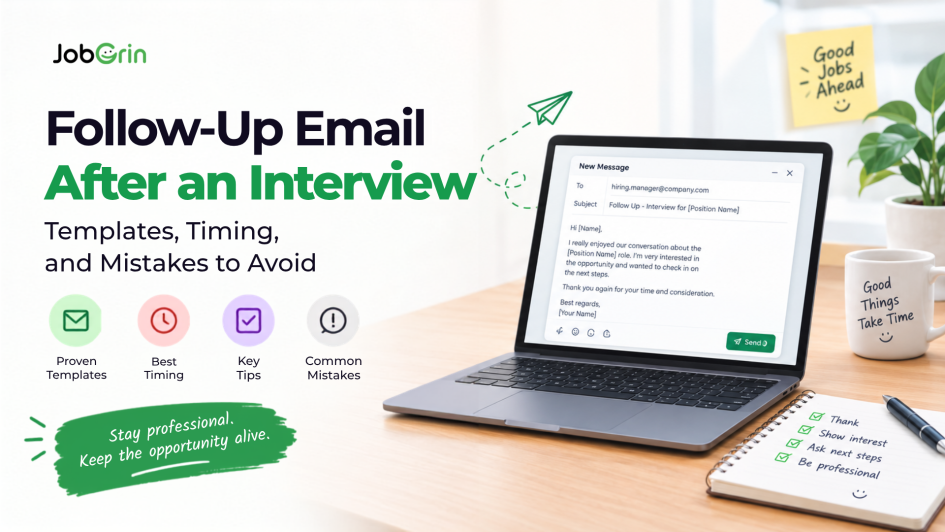
You’ve finished the interview.
Now comes the difficult part: waiting.
You may be wondering:
Should I send a follow-up? How long should I wait? Should I email the recruiter or hiring manager? What should I say? Will following up make me look desperate? What if they haven’t responded? Should I send another message?
A well-written follow-up email after an interview should be short, polite, and useful – it shouldn’t pressure the employer for an immediate decision.
In this guide, you’ll learn how to follow up after an interview, when to send your message, what to include, what to do if you receive no response, and several ready-to-use email and message templates.
TL;DR: How to Follow Up After an Interview
Here’s the simple process:
- Thank the interviewer after the interview.
- Follow the communication timeline they provided.
- If no timeline was provided, wait a reasonable amount of time before checking in.
- Send a short and professional message.
- Mention the position you interviewed for.
- Reconfirm your interest.
- Ask politely about the hiring process or next steps.
- Avoid repeatedly messaging the recruiter.
- If you receive a response, follow the employer’s timeline.
- Continue your job search while waiting.
The goal of a follow-up isn’t to pressure the employer. It’s to maintain professional communication and show continued interest.
What Does It Mean to Follow Up After an Interview?
Following up means contacting the employer after your interview to:
- Thank them for their time
- Express continued interest
- Ask about the next steps
- Check the status of your application
- Provide additional information if requested
A follow-up can be sent by email, LinkedIn message, recruiter communication channel, or another method the employer has specifically used with you. Email is usually the safest and most professional option when an email address has been provided.
Should You Follow Up After a Job Interview?
Yes, in many situations a short follow-up is appropriate.
A professional follow-up can help you thank the interviewer, reinforce your interest, maintain communication, clarify next steps, and check the status of your application.
However, following up doesn’t guarantee that you’ll get the job. The hiring decision depends on the employer’s evaluation, other candidates, business requirements, and the overall hiring process, for more on what’s actually shaping hiring decisions right now, see why hiring in India feels slower than it used to.
When Should You Follow Up After an Interview?
The best timing depends on what the interviewer told you.
If the interviewer gave you a timeline – follow it. If they say “We’ll get back to you by Friday,” wait until that period has passed before checking in, unless they contact you earlier.
If no timeline was given – give the employer a few business days to process the interview internally before sending a check-in. The exact window can shift with company size, hiring urgency, number of interview rounds, and role seniority, but as a working default: wait 5-7 business days before your first follow-up if nothing else was said. Don’t assume that a lack of immediate response means rejection – internal approvals and scheduling are the more common cause, something recruiters have flagged repeatedly around candidate engagement during hiring.
Should You Send a Thank-You Email Immediately?
Yes – a brief thank-you message the same day or next business day is standard. Keep it short: thank the interviewer for their time, mention something relevant you discussed, and confirm your interest.
This is different from the later status follow-up. The thank-you focuses on appreciation; the follow-up focuses on the hiring process and next steps.
What Should You Include in an Interview Follow-Up Email?
A good follow-up email has five elements:
- Greeting – address the person professionally.
- Thank them – for taking the time to interview you.
- Mention the position – remind them which role you interviewed for.
- Express interest – briefly confirm you’re still interested.
- Ask about next steps – politely ask for an update on the hiring process.
Keep the email concise.
Simple Follow-Up Email Structure
Subject: Follow-Up on [Job Title] Interview
Greeting – thank them for the interview.
Middle – mention your continued interest in the role.
Closing – ask about the next steps and thank them again.
You don’t need several paragraphs.
Interview Follow-Up Email Template
Dear [Interviewer Name],
Dear [Interviewer Name],
Thank you for taking the time to interview me for the [Job Title] position.
I enjoyed our conversation and remain very interested in the opportunity.
I wanted to check if there are any updates regarding the next steps in
the hiring process.
Thank you again for your time. I look forward to hearing from you.
Best regards,
[Your Name]
Follow-Up Email After a Second or Final Interview
Dear [Interviewer Name],
Thank you again for taking the time to speak with me regarding the
[Job Title] position.
I appreciated the opportunity to learn more about the team and the
responsibilities of the role. Our discussion further strengthened
my interest in joining [Company Name].
I wanted to follow up to see if there are any updates regarding
the hiring decision or next steps.
Thank you for your consideration. I look forward to hearing from you.
Best regards,
[Your Name]
Interview Follow-Up Email Template for a Recruiter
Hi [Recruiter Name],
I hope you’re doing well. I wanted to follow up regarding my
interview for the [Job Title] position. I’m still very interested
in the opportunity and wanted to check if there are any updates
regarding the next steps in the hiring process.
Thank you!
Short WhatsApp Follow-Up Message
Hello [Name], I hope you’re doing well. I wanted to follow up regarding my interview for the [Job Title] position. I remain interested in the opportunity and wanted to check if there are any updates on the next steps. Thank you.
LinkedIn Follow-Up Message
Hi [Name], thank you again for speaking with me about the [Job Title] opportunity at [Company Name]. I enjoyed learning more about the role and remain very interested. I wanted to check if there are any updates regarding the next steps in the hiring process. Thank you!
Follow-Up After Interview When They Said “We’ll Get Back to You”
Wait until the timeframe they mentioned has passed, then write:
Dear [Interviewer Name],
I hope you’re doing well.
I wanted to follow up regarding my interview for the [Job Title]
position. During our conversation, you mentioned that I could expect
an update around [day/timeframe], so I wanted to check whether there
have been any updates regarding the next steps.
I’m still very interested in the opportunity and appreciate your
time and consideration.
Best regards,
[Your Name]
What If You Haven’t Received a Response?
This is one of the most common situations candidates face. Don’t immediately assume rejection, the employer may be interviewing other candidates, waiting on internal approval, coordinating schedules, or dealing with shifting priorities. Hiring processes don’t always move on the original timeline, and broader hiring-market conditions in India can slow even well-run pipelines.
How Long Should You Wait Before Following Up Again?
If you’ve already sent one follow-up and heard nothing, don’t send messages every day. Give it another 5-7 business days. If there’s still no response, one more concise follow-up is reasonable:
Dear [Interviewer Name],
I hope you’re doing well.
I wanted to briefly follow up regarding the [Job Title] position
and see if there are any updates on the hiring process.
I remain interested in the opportunity and would appreciate any
update you can share when convenient.
Thank you again for your time.
Best regards,
[Your Name]
After that, it’s usually better to move forward with your job search rather than repeatedly contacting the employer.
What If the Company Has Gone Completely Silent?
You can send one final professional check-in, but don’t let a single application stall your whole job search. Keep applying, attending interviews, networking, and building skills. Until you have a formal offer, treat the opportunity as still uncertain – see how to find a job as a fresher with no experience if you’re rebuilding your pipeline from scratch.
How to Follow Up After an Interview Without Sounding Desperate
| Avoid | Instead |
| “Why haven’t you replied?” | “I wanted to follow up regarding the status of my application.” |
| “Please let me know if I got selected.” | “I wanted to check if there are any updates regarding the next steps.” |
| “I’m waiting for your response.” | “I remain interested in the opportunity and would appreciate any update when convenient.” |
Should You Ask If You Got the Job?
You can ask about status, but avoid demanding a yes-or-no immediately. Instead of “Did I get the job?” use: “I wanted to check whether there are any updates regarding the hiring decision or next steps.” It’s more professional and gives the employer room to explain.
Should You Call the Recruiter After an Interview?
Only if they specifically invited you to call, phone has been the normal communication method, or you have an urgent, legitimate reason. If the process has run entirely through email, calling repeatedly is usually unnecessary, email is the safer default.
What If You Have Another Job Offer?
Dear [Interviewer Name],
I hope you’re doing well.
I wanted to follow up regarding my interview for the [Job Title]
position. I remain very interested in the opportunity and enjoyed
learning more about the role and team.
I also wanted to let you know that I have received another offer
and have been asked to respond by [date]. If possible, I would
appreciate any update you can provide regarding the expected
timeline for this position.
Thank you for your understanding and consideration.
Best regards,
[Your Name]
Be honest about the offer and deadline. Don’t invent one to pressure the employer.
What If You Need to Send Additional Information?
If you forgot to mention something relevant, include it only if it genuinely adds value — for example, a portfolio piece discussed during the interview. Don’t send documents just to manufacture a reason to follow up.
Common Follow-Up Mistakes
- Following up too quickly
- Sending multiple messages every day
- Writing a very long email
- Sounding demanding
- Asking only “Any update?” with no context
- Repeating the same message verbatim
- Contacting multiple employees at once
- Sounding desperate
- Complaining about delays
- Stopping your job search
What Should the Subject Line Be?
Good: “Follow-Up on [Job Title] Interview,” “Interview Follow-Up – [Job Title],” “Checking In – [Job Title] Interview.” Avoid: “Hi,” “Update?,” “Important,” “Please Reply.”
How to Follow Up With a Hiring Manager vs. HR
If you have the hiring manager’s direct contact and they’ve communicated with you before, keep your follow-up focused on the position, your interest, and next steps, this isn’t the moment for a fresh sales pitch on yourself; that was the interview itself.
If HR is managing the process, direct your follow-up to the HR representative and reference the interview date so they can find your file quickly. It also helps to know how HR typically evaluates interview performance so your follow-up doesn’t accidentally reopen a case you already made well.
What If the Interviewer Asked You to Complete a Task?
Complete it carefully and submit it on time. Your follow-up can simply confirm submission and restate interest – don’t chase feedback on the assignment itself.
What If You Were Rejected?
Dear [Name],
Thank you for letting me know and for giving me the opportunity
to interview for the [Job Title] position.
Although I’m disappointed that I wasn’t selected, I appreciate
the time you and the team spent speaking with me and helping me
learn more about the role.
If you’re able to share any feedback about my interview or
application, I would be grateful for the opportunity to learn
and improve.
Thank you again, and I wish you and the team all the best.
Best regards,
[Your Name]
Not every employer will provide feedback – don’t take it personally if they don’t respond.
What If You Get the Job?
Respond professionally and review the offer carefully before accepting: job title, salary, benefits, work location and mode, working hours, joining date, notice requirements, and probation terms. Pay particular attention to the notice period rules that apply in India before you resign from your current role – don’t quit on a verbal confirmation alone; wait for the formal offer letter.
Interview Follow-Up Checklist
- Correct recipient
- Correct company name and job title
- Professional greeting
- Thanked the interviewer
- Mentioned continued interest
- Asked about next steps
- No unnecessary paragraphs
- No demanding language
- No spelling mistakes
- Professional sign-off
Follow-Up Timeline Example
Day 0 – Complete the interview, send a short thank-you.
Employer’s stated deadline – wait for it.
After the timeline – send a polite follow-up if you haven’t heard back.
5-7 business days later – one additional follow-up, if needed.
After that – continue your job search rather than repeatedly contacting the employer.
Why You Should Keep Applying for Other Jobs
An interview is not a guarantee, even when the interviewer says “we really liked your profile.” Keep applying, networking, interviewing, and improving your resume until you have a formal offer – a resume that survives applicant tracking systems will do more for your pipeline than a perfectly worded follow-up email ever will.
Frequently Asked Questions
How do I follow up after an interview?
Send a short, professional email or message thanking the interviewer, confirming your interest, and politely asking about the next steps in the hiring process.
How long should I wait before following up after an interview?
Follow the timeline the employer gave you. If none was given, 5-7 business days is a reasonable default before your first check-in.
Is it okay to follow up after an interview?
Yes. A professional follow-up can show continued interest and help you understand the status of the hiring process.
What should I say in a follow-up email after an interview?
Thank the interviewer, mention the position, confirm your interest, and politely ask whether there are updates regarding the next steps.
Should I follow up if the interviewer said they would contact me?
Yes, but wait until the timeframe they provided has passed before checking in.
What if the interviewer doesn’t respond to my follow-up?
Give them additional time. If necessary, send one more concise follow-up, then continue your job search rather than repeatedly contacting them.
Should I call HR after an interview?
Only if calling fits the established communication process or the recruiter has invited you to call. Otherwise, email is usually more appropriate.
Can I follow up through WhatsApp?
If the recruiter has already been communicating with you through WhatsApp, a short professional message is fine.
Can I follow up on LinkedIn?
Yes, particularly if LinkedIn has already been the channel of communication. Keep it brief and professional.
What if I receive another job offer while waiting?
Tell the employer honestly about the offer and any response deadline, and politely ask for a timeline update.
How many times should I follow up after an interview?
There’s no universal number, but repeated messages are usually unnecessary. Follow the employer’s timeline and keep any additional follow-up concise.
Does following up increase my chances of getting hired?
A follow-up can’t guarantee selection. Its main purpose is to maintain professional communication and confirm your continued interest.
Should I stop applying for jobs after an interview?
No. Continue your job search until you have received and accepted a formal job offer.
Final Thoughts
Waiting after a job interview can be stressful, especially when you don’t know what’s happening behind the scenes. A professional follow-up email makes the waiting period easier by giving you a way to check on the hiring process without pressuring the employer.
The formula is simple: thank them → confirm your interest → ask about next steps → give them time.
Don’t send messages every day. Don’t demand an immediate decision. Don’t assume silence automatically means rejection. And don’t stop your job search because one interview went well.
Leave a Reply