The best interview questions to ask a Python developer test practical coding, debugging, data handling and communication against the work you need done. Start hiring with JobGrin’s Free Starter plan, which includes three job posts a month, or create a Python developer job post.
Use the 30 questions below as a question bank, not a script for every interview. Each includes a signal to listen for, plus a way to compare candidates consistently.
Quick answer: which interview questions should you ask a Python developer?
The short rule in one line: Match the questions to the actual role and score the evidence, not the jargon.
- Start with fundamentals. Ask about data structures, errors and readable code.
- Test real work. Add questions on APIs, databases, testing or automation as the role requires.
- Use a shared scorecard. Ask comparable questions and record specific evidence for each candidate.
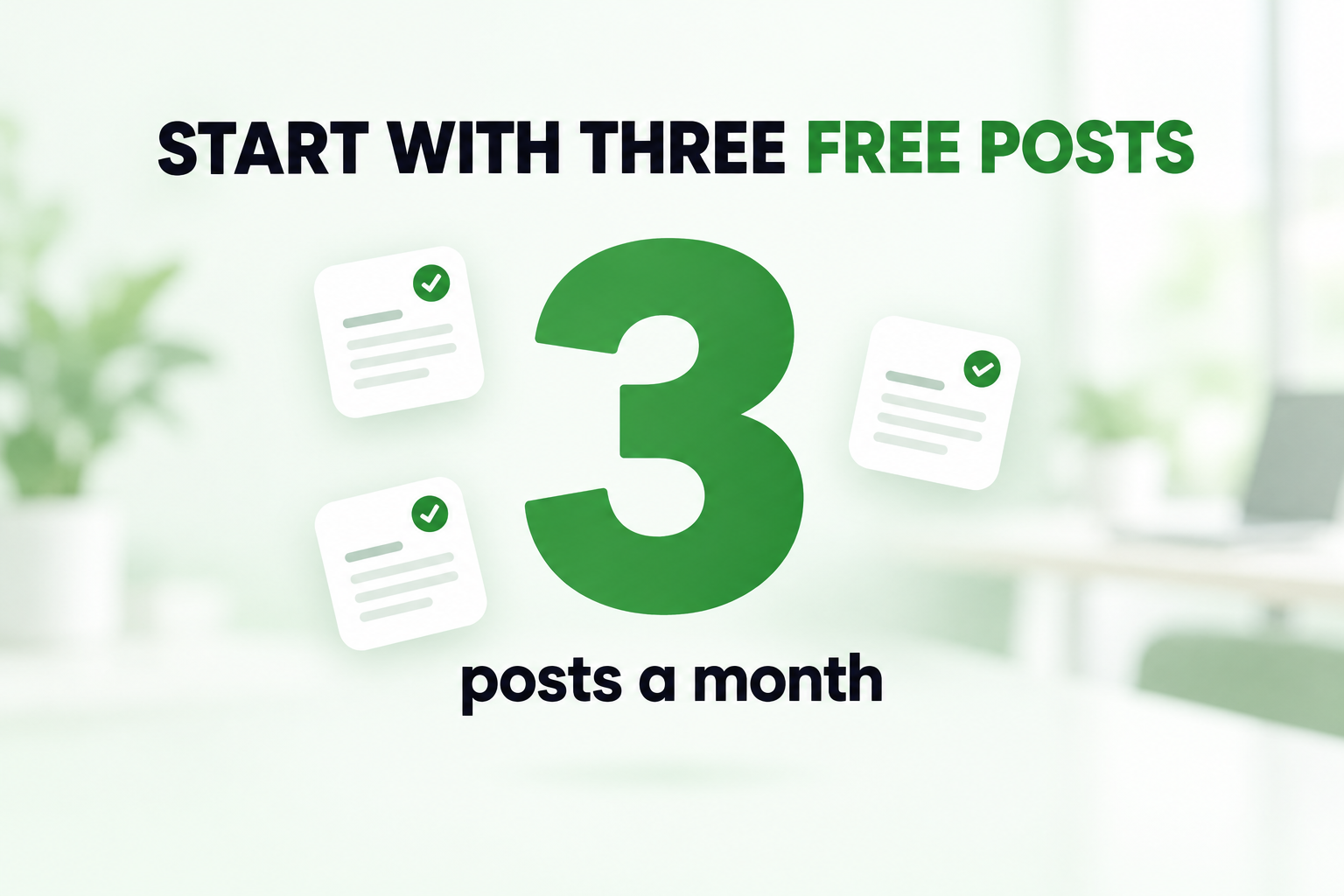
- Start with a free post. JobGrin Free Starter includes three job posts a month.
Choose from the question bank below, then use the scorecard to make a defensible comparison.
Interview Questions to Ask a Python Developer
Choose six to ten questions for an initial technical conversation, then add a small work sample. Select questions that reflect the developer’s expected responsibilities, rather than testing every Python topic.
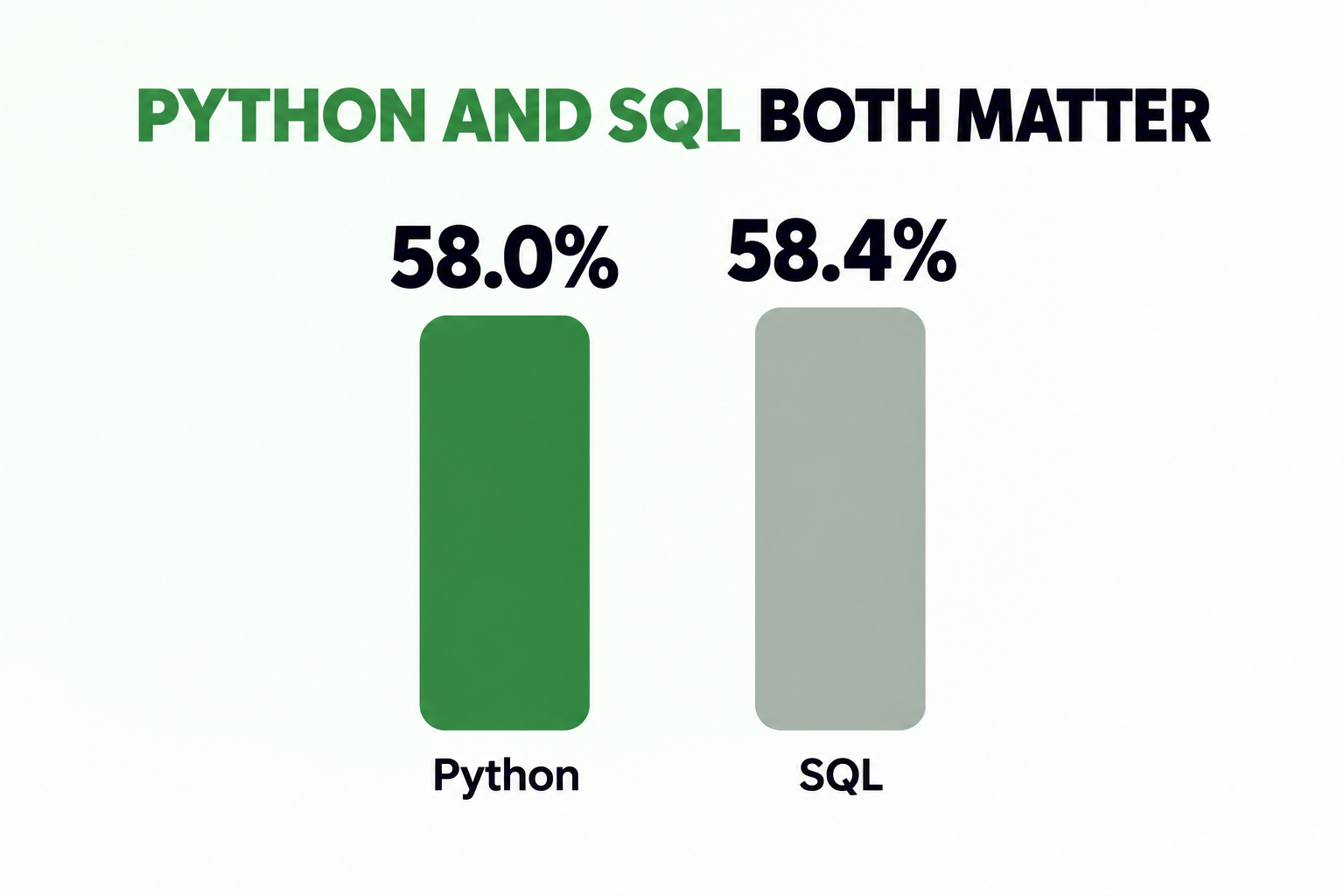
SQL deserves attention for database-heavy roles. In Stack Overflow’s 2026 Developer Survey, 58.0% of 14,099 respondents to the language question used Python extensively, while 58.4% of 14,099 respondents used SQL extensively. These are survey responses, not measures of India’s hiring market.
Python Fundamentals and Data Structures
1. When would you use a list, tuple, set or dictionary? A good answer connects the choice to the task: ordered mutable collections, fixed sequences, unique values or key-value lookups. Ask which structure fits the role’s data.
2. What is the difference between mutable and immutable objects? Look for an explanation that a list can change in place, while a string or tuple cannot. A strong candidate explains how shared references can expose changes elsewhere.
3. What happens when a function uses a mutable default argument? A good answer recognises that the default object is created when the function is defined and reused. The candidate suggests using None and creating a new list inside the function.
4. How would you remove duplicates while preserving order? Look for a clear approach, such as tracking seen values while building a result. Ask about the assumptions: values must be hashable for a set-based approach.
5. What are comprehensions, and when would you avoid them? A good answer uses a comprehension for a readable transformation or filter. The candidate switches to a loop when nesting or side effects make the expression difficult to understand.
6. What is the difference between an iterator and a generator? Listen for an iterator that produces values on demand and a generator as one convenient way to create an iterator. A useful follow-up asks why this helps with large files.
Code Quality, Types and Errors
These six questions reveal whether a candidate can make Python code understandable and maintainable. Ask for a short example rather than a memorised definition.
Understandable Code and Type Hints
7. What do type hints do in Python? A good answer says they document expected types and help external tools find inconsistencies. Type hints do not, by themselves, enforce types at runtime.
8. How would you review an AI-generated Python function? Look for a candidate who reads the code, checks requirements, runs tests and inspects edge cases. They should explain any code they keep, rather than treating generated output as proof of correctness.
Meta’s 2026 Python Typing Survey found that 93.6% of 1,571 respondents to its reasons question selected readability or documentation. In the same survey, 42.5% of 1,517 respondents to an AI-related question reported AI-written type hints. Both findings make explanation and review useful interview topics.
9. How would you refactor a long function? A good answer starts by understanding its behaviour and adding tests where needed. The candidate then separates responsibilities into small, named functions without changing the result.
Exceptions and Resource Handling
10. How do you decide which exceptions to catch? Listen for specific exceptions and a recovery or reporting action. Catching every exception without recording or handling it can hide the original problem.
11. What does a context manager do? A good answer explains that a with block manages setup and cleanup, including when an exception occurs. Opening a file is a straightforward example.
12. How would you investigate a production error? Look for a sequence: understand the impact, examine logs and the traceback, reproduce the issue safely, then test a fix. Strong answers also mention checking whether the fix addresses the cause.
Testing and Security Questions
Use these six questions when the developer will maintain code, handle user input or deploy changes. A good answer gives a practical example and acknowledges a relevant failure case.
Tests That Catch Real Failures
13. What is the difference between a unit test and an integration test? A good answer explains that a unit test focuses on a small piece of behaviour, while an integration test checks components working together. Both can be useful for the same feature.
14. What would you test in a function that validates an email field? Listen for accepted and rejected inputs, empty values and the actual product rules. A strong answer avoids assuming that a simple pattern covers every valid address.
15. When would you mock an external service? A good answer uses a mock to make a focused test predictable or avoid a network dependency. The candidate also recognises that a separate integration test is needed to check the real interaction.
Safe Inputs and Dependencies
16. How would you prevent SQL injection? Look for parameterised queries rather than building SQL by joining user input into a query string. Ask the candidate to explain how the database driver handles the values.
17. How should an application handle passwords and secrets? A good answer separates secrets from source code and uses a suitable password-hashing approach for stored passwords. It also avoids printing credentials in logs.
18. How do you assess a new dependency? Listen for a check of whether the package solves the problem, its maintenance, compatibility and known vulnerabilities. A strong answer also considers the cost of removing it later.
Backend, Data and Concurrency Questions
These six questions are especially useful for backend and data roles. For an automation position, favour file processing and concurrency over framework trivia.
APIs and Database Behaviour
19. What makes an API endpoint easy to use? Look for clear inputs and outputs, appropriate status codes, validation and useful error messages. The candidate should connect their choices to the people or systems consuming the API.
20. How would you diagnose a slow database query? A good answer starts with measurement and the query plan. The candidate considers indexing, filtering, returned data and the number of queries before proposing a change.
21. What is an N+1 query problem? Listen for an initial query followed by an extra query for each result. A good answer suggests fetching related data efficiently, then measuring the improvement.
Concurrency and Large Inputs
22. When would you use threads, processes or asynchronous code? A good answer distinguishes waiting for input or output from CPU-heavy work. It explains trade-offs instead of treating one approach as universally faster.
23. What is Python’s global interpreter lock? Listen for the distinction between ordinary GIL-constrained execution and free-threaded Python. Python’s 3.15.2 documentation also notes that asyncio has supported free-threaded Python since 3.14, so avoid treating the GIL as an unchanging rule for every build.
24. How would you process a file too large for memory? Look for reading and processing it incrementally, rather than loading the entire file. A strong answer also considers malformed records and how to report or resume failed work.
Experience and Work Sample Questions
Use the final six questions to assess judgement and collaboration. Ask candidates to explain their own contribution without sharing confidential code or customer information.
Past Decisions and Collaboration
25. Tell me about a Python bug you diagnosed. A good answer explains the symptom, how the candidate narrowed the cause, the fix and a test that prevents recurrence. Probe for their personal contribution.
26. Describe a technical trade-off you made. Listen for the options, constraints and reason for the choice. A strong answer acknowledges what the team gave up and whether the decision worked.
27. How do you respond to a code review comment you disagree with? Look for a respectful discussion grounded in requirements, examples and maintainability. The candidate should be willing to reconsider or document the decision.
28. How would you explain a delay to a non-technical stakeholder? A good answer gives the impact, reason, options and next update in plain language. Avoid rewarding confidence alone; look for clarity and ownership.
Small, Relevant Work Samples
29. How would you test and fix this broken function? Give every candidate the same short function and expected behaviour. Look for a failing test, a targeted fix and a discussion of edge cases.
30. How would you add a field to an existing API? Look for validation, backwards compatibility, data handling and tests. For a data role, substitute a small transformation task with the same scoring criteria.
Give candidates the instructions and time allowance before they begin. Decide whether reference material or AI tools are allowed, and apply the same rule to everyone. Ask candidates to explain their own solution.
Choose a Job Posting Plan
Choose Free Starter for an initial Python vacancy. Use a paid plan when you need the relevant application capacity, listing features or a longer live period.
| JobGrin plan | Price excluding GST | Posting details |
|---|---|---|
| Free Starter | Free | 3 posts a month; up to 25 applications per post; each job live for 7 days; standard listings and email notifications |
| Quick Hire | ₹749 for 1 post | Up to 150 applications; live for 15 days; priority listing, basic AI matching and 72-hour search boost |
| Pro Recruit | ₹2,799 for 5 posts | Unlimited applications; live for 30 days per job; featured listings and AI candidate suggestions |
| Elite Prime | ₹4,999 for 10 posts | Unlimited applications; live for 45 days per job; top search placement and advanced AI matching |
18% GST is added at checkout. Drafts are free; a credit is used when a job is published. See the full features on JobGrin employer pricing.
Compare Posting Options
The table compares entry-level posting options and includes each provider’s published starting price. Apna’s paid bundle is included as a three-credit reference; features and posting periods differ.
| Provider and plan | Starting price and term | Relevant features |
|---|---|---|
| JobGrin Free Starter | Free; 3 posts a month | 25 applications per post; 7 days live per job |
| Apna 1 Month | ₹1,949 for 1 month | 3 job credits; jobs active for 15 days |
| Indeed Free to Post | Free; term not stated | Screening questions, candidate messaging and analytics; terms and usage limits apply |
| Wellfound Job Posts | US$0; free plan | Unlimited listings and built-in applicant tracking or tracking-system sync |
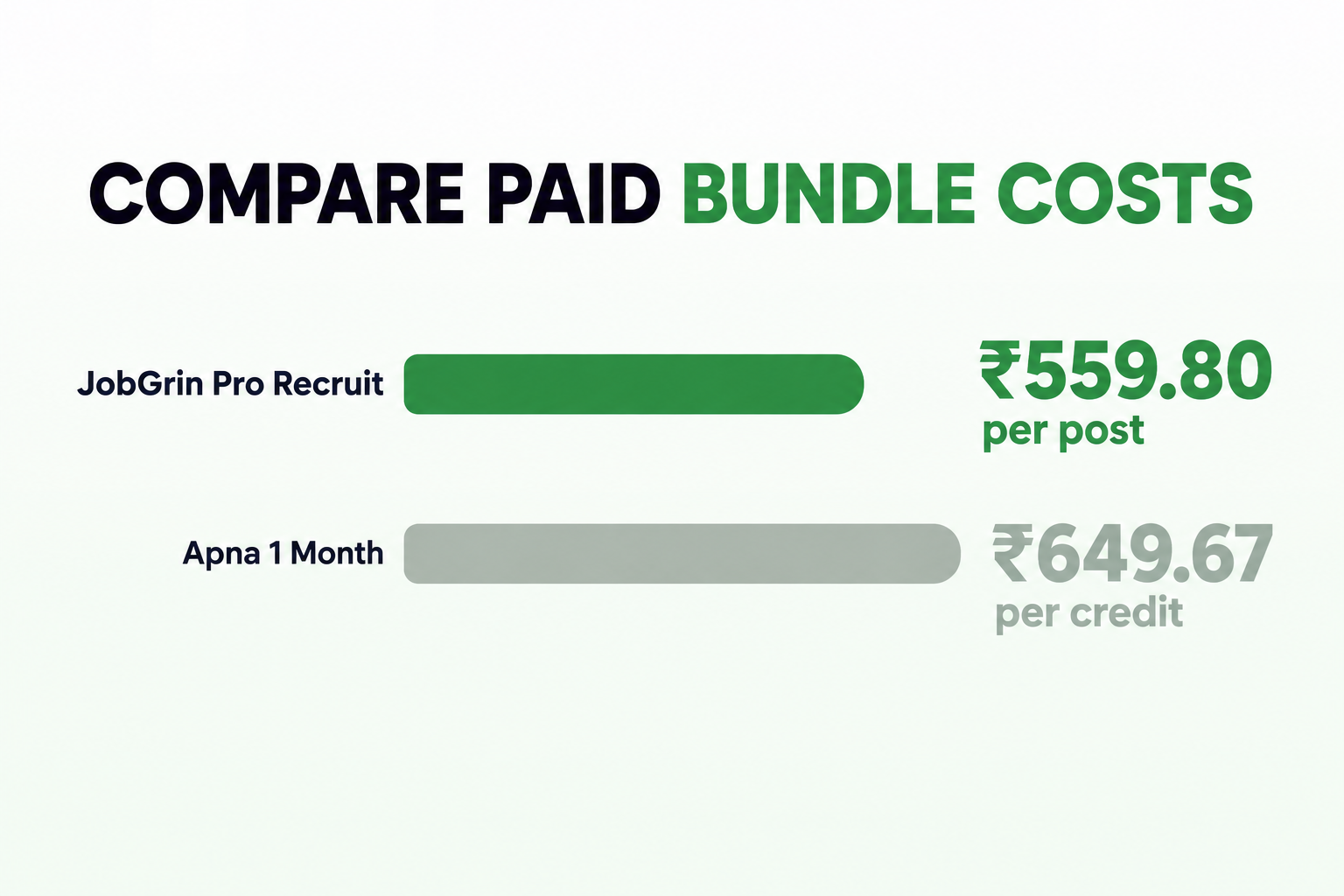
For a paid bundle comparison, JobGrin Pro Recruit costs ₹559.80 per post: ₹2,799 ÷ 5. Apna’s one-month bundle costs ₹649.67 per credit: ₹1,949 ÷ 3, rounded to two decimal places. The JobGrin figure excludes GST; the bundles have different durations and features.
In a GetApp review summary covering July 2021 to September 2024, Indeed reviewers praised reach, screening and applicant management. Wellfound reviewers on Capterra praised access to start-ups and easy applications; some mentioned unresponsive employers or difficulty judging listing activity. Reddit discussions also mention inactive listings alongside reports of successful hires. These are individual experiences, not platform-wide rates.
For an example, an employer with three Python vacancies can use Free Starter’s three monthly posts at no posting charge. If the employer prefers Pro Recruit’s features, the five-post bundle costs ₹2,799 excluding GST, including two additional post credits. Apna’s three-credit bundle costs ₹1,949 for one month; Indeed’s entry option is free, and Wellfound’s Job Posts plan starts at US$0. Check the application capacity and live period against the vacancy before choosing.
Score Answers Consistently
Use four criteria scored from zero to four for a practical interview. This makes the maximum 16 points, while keeping the discussion focused on evidence rather than impressions.
| Criterion | What strong evidence looks like | Maximum |
|---|---|---|
| Python fundamentals | Explains relevant language behaviour and chooses suitable data structures. | 4 points |
| Problem solving | Clarifies inputs, considers edge cases and works towards a correct solution. | 4 points |
| Testing and reliability | Proposes useful tests and explains how failures would be handled. | 4 points |
| Communication and judgement | Explains choices, trade-offs and personal contribution clearly. | 4 points |
Use the same anchors for each criterion: zero means no relevant evidence; one means a major gap; two means partial understanding; three means a sound answer; and four means a sound answer with useful trade-offs or edge cases.
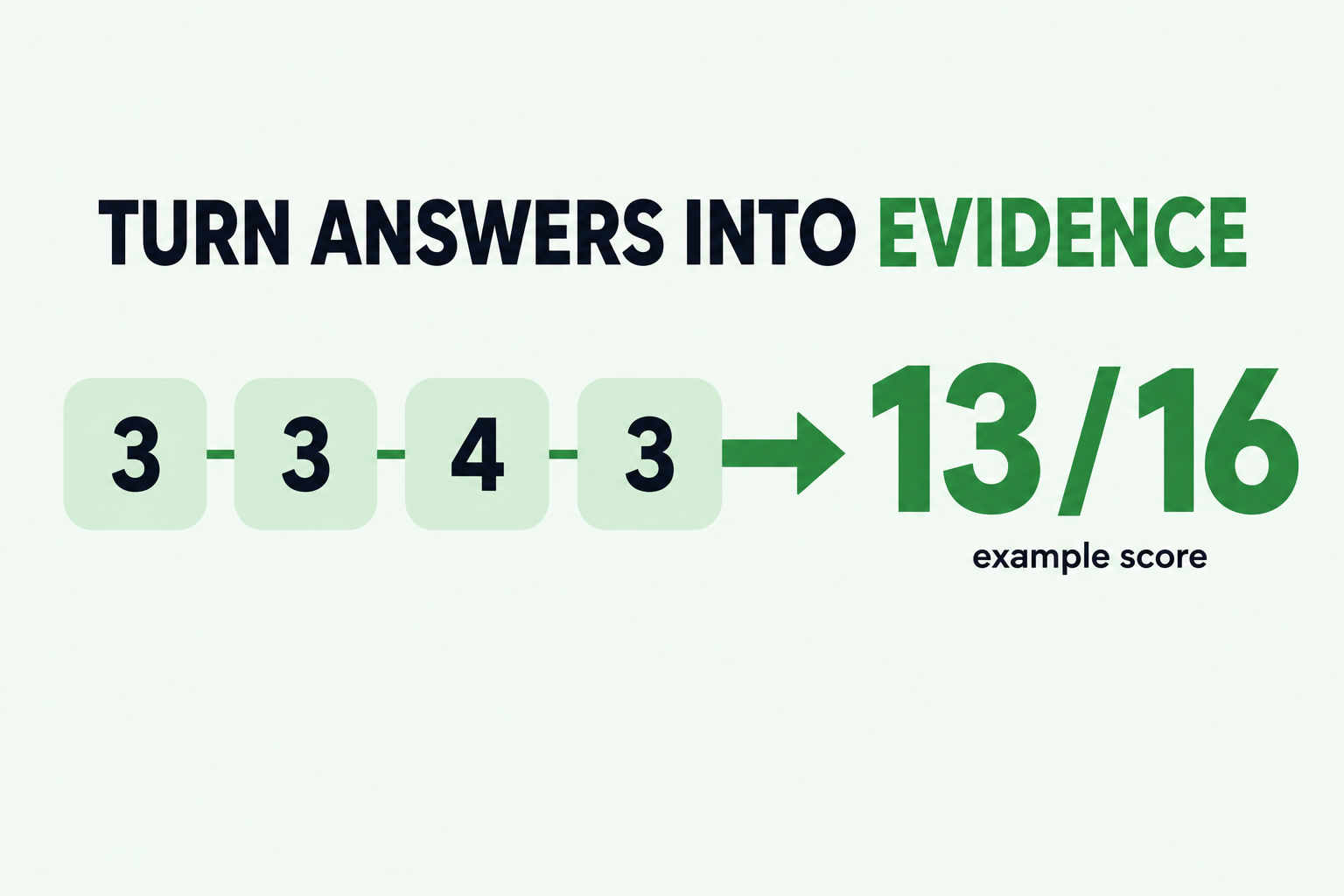
Example: For a backend vacancy, a candidate scores 3, 3, 4 and 3 across the four criteria. The total is 3 + 3 + 4 + 3 = 13 out of 16 points. Record the evidence behind each score, then compare it with the role’s essential requirements before making a decision.
Choose an API exercise when the role involves backend services. Choose a file-processing exercise when the daily work is automation. A junior candidate can explain a small solution; a senior candidate should also discuss design choices and operational risks.
Before interviews, use candidate search and resume access to review relevant experience. The JobGrin hiring guide also walks through the broader hiring process.
Frequently Asked Questions
How many Python questions should an employer ask?
Choose six to ten for an initial technical conversation. Follow with a relevant work sample if you need evidence of coding and debugging.
What should I ask a junior Python developer?
Focus on lists and dictionaries, functions, exceptions and basic tests. Ask the candidate to explain a small piece of code and how they would find an error.
What should I ask a senior Python developer?
Ask about trade-offs, production debugging, database performance and reviewing changes. Look for specific decisions and their consequences, not only broad architecture vocabulary.
Should every Python candidate answer framework questions?
No. Ask framework-specific questions when the role uses that framework. Otherwise, test transferable skills such as API design, data handling and testing.
How can a non-technical employer assess an answer?
Use the answer cues in this guide and ask for a concrete example. For a deeper assessment, have a qualified technical interviewer review the work sample and scorecard.
Should candidates be allowed to use AI during an exercise?
Either approach can work. State the rule in advance, apply it consistently and ask candidates to explain and test any code they submit.
Is JobGrin cheaper than the other posting options?
JobGrin Free Starter, Indeed’s entry posting option and Wellfound’s Job Posts plan all have a free entry point. Apna’s one-month bundle costs ₹1,949. Features, application capacity and live periods matter alongside price.
Which JobGrin plan suits several Python vacancies?
Free Starter includes three posts a month. Pro Recruit includes five posts and featured listings for ₹2,799 excluding GST, making it an option when those features fit the hiring work.
What should I check before changing a posting platform?
Compare the number of posts, live periods, application limits, screening tools and total price. Keep interview questions and scoring criteria consistent so platform choice does not change your assessment.
Final Thoughts
The strongest interview questions to ask a Python developer reveal how the candidate solves problems, tests assumptions and explains decisions. Use the same core questions and scoring anchors for comparable roles.
Keep the exercise close to the work the developer will actually do. Record evidence, discuss trade-offs and use the scorecard to guide the hiring conversation.
Leave a Reply