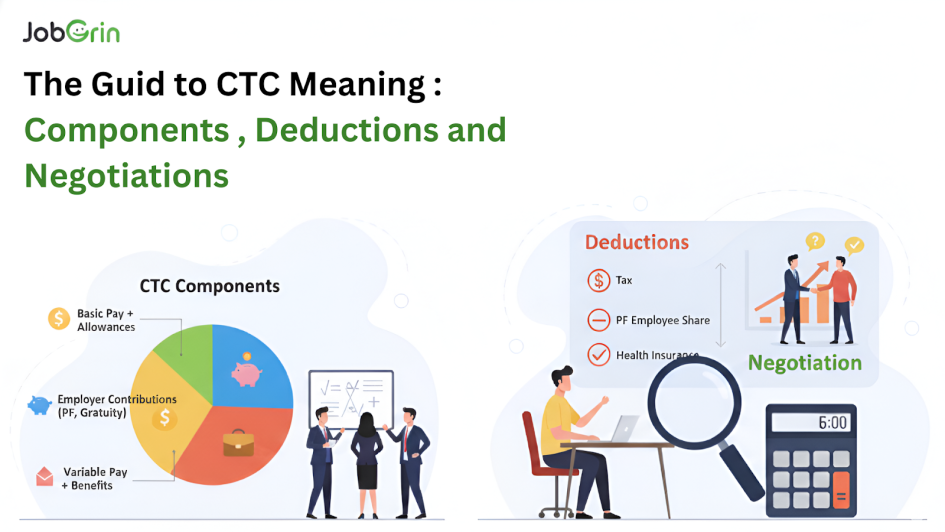
You just landed a job with a high CTC (e.g., ₹15 Lakh), only to find your Take-Home Salary is significantly less. This gap is the central mystery in modern employment. Before signing, you must understand every component and deduction that determines the headline number.
This guide will make you an expert on CTC components, empowering you to negotiate your actual value.
What is CTC (Cost to Company)?
In simple terms, CTC is the total expense your employer incurs annually for having you on the payroll.
- It’s the Company’s Expense: CTC is the annual amount that covers everything your employer spends on you: your monthly salary, your insurance premium, their share of your retirement savings (PF), and even specific allowances.
- CTC is not the money you take home (Net Salary). The amount that hits your bank account is always lower because CTC includes costs that are either deducted, saved, or paid to a third party on your behalf (like tax or the company’s contribution to your PF).
Key Components of CTC Structure
To decode your CTC price tag, you need to break it down into four distinct categories. Knowing where every rupee is allocated is the first step toward financial empowerment.
1. Fixed Components
Fixed Components are the core, guaranteed part of your CTC that is included in your monthly paycheck.
- Basic Salary: The backbone of your compensation. It typically makes up 40% to 50% of your total CTC and is fully taxable. Crucially, almost all other allowances and statutory contributions (like PF) are calculated based on this amount.
- House Rent Allowance (HRA): Provided to cover your accommodation costs if you live in rented housing. HRA is a vital component because it is partially tax-exempt under specific conditions, making it a key tool for tax savings.
- Dearness Allowance (DA): Common in government and public-sector jobs, this allowance helps employees cope with the rising cost of living (inflation).
- Special/Other Allowances: A catch-all component used by companies to balance the package. It is generally fully taxable and often represents the remaining portion of your fixed pay that doesn’t fit into other defined categories.
2. Variable Components
This portion of your compensation is performance-based and therefore not guaranteed. It is paid out only upon achieving specific targets or milestones.
- Performance Bonus: Linked to your individual or team performance, or the company’s annual profit.
- Sales Incentives/Commission: Paid to sales-focused roles based on the revenue or targets achieved.
- Stock Options (ESOPs): The right to buy company shares at a discounted price in the future. Their value is variable and depends on the company’s stock price.
3. Statutory & Employer Contributions
These are costs incurred by the employer for your long-term security. They are included in the CTC but are never paid to you in cash.
- Employer’s Provident Fund (PF): The company’s mandatory contribution (12% of your Basic Salary) to your retirement fund.
- Gratuity: A lump sum paid to you when you leave the company after completing a minimum of five years of service.
- Employee State Insurance (ESI): Contribution toward a government scheme for medical and disability benefits (for employees below a certain salary threshold).
- Health Insurance Premium: The premium paid by the company for any group medical insurance policy covering you or your family.
4. Reimbursements & Other Allowances
These components are typically claim-based and often structured to offer tax efficiency, as they cover work-related or specific personal expenses.
- Leave Travel Allowance (LTA): Reimbursement for travel expenses taken during your leave. It is tax-exempt up to specific limits upon submission of proof.
- Medical Reimbursement: Can be claimed for medical expenses incurred by you or your family, often up to a fixed annual limit.
- Fuel / Telephone / Internet Allowance: Amounts paid to cover expenses related to work communication or commuting. These may be fully taxable or partially exempt depending on the nature of the allowance and the current tax regime.
How to Calculate Your CTC and In-Hand Salary?
Understanding the formula is key to moving from confusion to clarity. The calculation of your final take-home salary is a step-by-step subtraction process that starts with the highest figure (CTC).
Step 1: Calculating the Total CTC
Your CTC is the sum of everything the employer spends on you annually.
CTC = Direct Benefits + Indirect Benefits + Statutory Contributions (Employer’s Share)
Step 2: Finding Your Gross Salary
Gross Salary is the amount paid to you before any of your personal deductions (like tax or your share of PF) are taken out. It is found by removing the expenses the employer paid to external parties on your behalf.
Gross Salary = CTC − Employer’s Statutory Contributions (PF + Gratuity + ESI)
Step 3: Determining Your Net (In-Hand) Salary
Net Salary (or Take-Home Salary) is the actual cash you receive monthly. Net Salary is calculated by removing the mandatory and voluntary CTC deductions from your Gross Salary.
Net Salary = Gross Salary − (Employee PF + TDS + Professional Tax + Voluntary Deductions)
Example: Decoding a ₹10,00,000 CTC
Let’s see how a typical ₹10 Lakh CTC is broken down into your bank account deposit.
| Calculation Steps | Amount | Formula / Notes |
|---|---|---|
| Start with CTC | 10,00,000 | The total cost to the company. |
| Minus Employer Contributions | -67,240 | (PF + Gratuity) – The company saves this for you. |
| EQUALS GROSS SALARY | 9,32,760 | |
| Minus Employee Deductions | ( These CTC deductions are your money being allocated ) | |
| Employee PF | -48,000 | Your matching contribution to your retirement fund. |
| Income Tax (TDS) | -80,000 | (Estimate based on tax regime and deductions) |
| Professional Tax (PT) | -2,400 | |
| EQUALS ANNUAL NET SALARY | 8,02,360 | |
| MONTHLY IN-HAND SALARY | ₹66,863 | (₹8,02,360 / 12) |
As you can see, the ₹10 Lakh CTC resulted in a monthly take-home of only around ₹66,863, a difference of over 33% from the headline figure. This highlights why your next step should be about maximizing that final take-home figure through strategic negotiation.
Strategy for CTC Negotiation: Maximizing Your Take-Home Pay
Understanding your CTC components and CTC deductions is only half the battle; the real value is using this knowledge to influence your offer. A good negotiation is not just about increasing the total CTC, but about strategically restructuring the components to maximize your monthly cash flow and long-term savings.
Increase the Basic Salary:
While this means more tax, it’s the foundation for your future wealth, as higher Basic Pay directly maximizes your long-term benefits, such as PF and Gratuity. Ideally, request that your Basic Salary be closer to 50% of your CTC, rather than the lower 40%.
Balance your PF Contribution:
Companies sometimes base PF on the statutory minimum wage, but you should insist it’s calculated on your actual Basic Salary to maximize your tax-efficient savings.
Maximize Tax-Friendly Allowances:
It means swapping funds from the fully taxable Special Allowance into components such as HRA (if you rent) and LTA, or meal/food coupons. It is a legitimate way to reduce your taxable income and boost your Net Salary.
Asking The Right Questions:
When you receive an offer, avoid simply saying, “ I want more money.” Instead, ask targeted questions to demonstrate your financial literacy regarding the CTC structure:
- “What is the exact percentage of Basic Salary in this CTC structure?” (Look for 40% to 50%).
- “Can we restructure the Special Allowance into HRA/LTA to optimize tax efficiency for my financial situation?”
- “What is the monthly estimated deduction for Income Tax (TDS) based on the current structure?” (This is the best way to determine the initial take-home salary.)
If you’re preparing for an interview that leads to this negotiation, make sure you’re ready with your answers: Why Should We Hire You – 15+ Supreme Answers, and perfect your presentation with 27 Body Language Tips For Your Job Interview.
By approaching the offer with a deep understanding of components, deductions, and tax implications, you shift the conversation from a simple demand to a strategic discussion, ensuring the Total Cost to Company truly reflects your maximum worth in hand and in the long term.
Conclusion:
The CTC figure is a marketing tool for the company. The breakup is your blueprint for financial freedom. By turning the “missing money” mystery into a straightforward equation of salary, benefits, and deductions, you gain the clarity needed to make informed career decisions, plan your finances effectively, and negotiate salary CTC compensation like a true expert.
Quick Answers for Understanding Your CTC
Q1: What is the main difference between CTC and Take-Home Salary?
CTC is the total annual cost the company spends on you (including employer contributions and non-cash benefits). Take-Home Salary (Net Salary) is the actual cash you receive after all mandatory deductions (Employee PF, TDS, Professional Tax) are subtracted.
Q2: What are the three core parts of a typical CTC package?
They are Fixed Components (Basic Salary, HRA), Employer Contributions (PF, Gratuity), and Variable Components (Performance Bonuses/Incentives).
Q3: Is my annual performance bonus part of the CTC?
Yes, Variable Pay (bonuses, commissions) is always included in the CTC figure, but since it is not guaranteed, it should never be factored into your expected monthly budget.
Q4: How does Basic Salary affect my long-term finances?
Basic Salary is crucial because statutory benefits such as Provident Fund (PF) and Gratuity are calculated as a percentage of this amount. A higher basic salary means a larger retirement corpus.
Q5: What is the best component to negotiate for a higher take-home salary?
Negotiate to increase tax-exempt allowances like HRA (if renting) or LTA, and reduce the fully taxable Special Allowance. It directly lowers your tax liability and increases your net pay.
Q6: Why is CTC higher than Gross Salary?
CTC is higher because it includes the Employer’s Contributions (like their share of PF and Gratuity liability), which are company expenses that are never part of your Gross Salary.
Leave a Reply